"Before evaluating any headline welcome bonus or payout multiplier, inspecting the underlying table rules and regulatory environment is paramount. A clear editorial review begins with what can be verified: wagering mechanics, house edge, and compliance under local laws." — Claire Bennett, Senior iGaming Content Editor
Online Blackjack Guide: Rules, Basic Strategy, Table Variants and Live Casino Mechanics (2026)
Last reviewed: January 2026 · Reviewed by: Claire Bennett, Senior iGaming Content Editor · Editorial methodology: our iGaming review matrix
Blackjack remains one of the most widely played casino table games in the world. It pairs a simple counting mechanic with real decision-making, which is rare among casino products. Online blackjack sits at the intersection of game probability and regulatory compliance, so players need to weigh table rules, payout ratios and platform safety before committing real funds. In Australia, interactive gambling laws govern online casino availability tightly, which places blackjack online inside a framework built to limit consumer risk and to keep unlicensed operators out of reach.
That legal context matters more than any bonus banner. Read it first.

Quick Summary
- Objective:Beat the dealer's hand total without exceeding 21. A two-card Ace + 10-value hand is a natural blackjack and should pay 3:2; tables paying 6:5 add roughly 1.39% to the house edge and are best avoided.
- Strategy:Correctly applied basic strategy compresses the theoretical house edge to roughly 0.5% under standard S17 six-deck rules, but it never removes the operator's mathematical advantage and never guarantees a winning session.
- Card counting:Structurally ineffective in RNG blackjack, where the virtual shoe is reshuffled every hand, and heavily restricted in live studios by continuous shuffling machines and shallow shoe penetration.
- Bonuses:Blackjack usually contributes only 5%–10% toward wagering requirements. A 35x bonus at 5% game weighting equals 700x effective turnover, which makes conversion mathematically improbable.
- Australian legal reality:Real-money online casino games, including blackjack, cannot lawfully be offered to Australian residents under the Interactive Gambling Act 2001, and credit-card deposits for licensed interactive wagering have been banned since June 2024.

General information disclaimer: This article is general information only and is not legal, financial or clinical advice. Verify the legal status of online gambling in your own jurisdiction before registering with any platform, and never wager funds you cannot afford to lose.
What This Guide Covers
- What is online blackjack and the objective of the game
- Card values and the natural blackjack combination
- How a hand plays out between player and dealer
- Blackjack rules: player actions and mandatory dealer decisions
- Advanced table rule modifiers to inspect
- Dealer rules: soft 17, deck count and house edge
- Blackjack strategy: the mathematical baseline
- Card counting basics and online mechanics limitations
- Bankroll management and the limits of strategy
- Types of blackjack games: classic, European and live blackjack
- Live dealer studios and providers
- Blackjack Switch, Perfect Pairs and other side bets
- Blackjack demo, free games and real-money play
- How to choose a blackjack casino
- Bonuses, welcome offers and turnover mathematics
- Payments, table limits and mobile play in Australia
- How to start playing live blackjack step by step
- FAQ
- About the author and editorial methodology
- Appendix A: Editorial revisions log

What Is Online Blackjack and the Objective of the Game
Blackjack is a comparing card game played directly between the player and the dealer blackjack table. The objective is to finish with a hand total closer to 21 than the dealer, without going over. Each player competes individually against the dealer's hand, so player hands do not directly affect each other's mathematical outcomes beyond the sequential removal of cards from the shoe. A total above 21 is an automatic loss, called a bust, regardless of what the dealer does afterwards.
Historical context: one of the earliest documented references to a blackjack-style game appears in Miguel de Cervantes' 17th-century short story Rinconete y Cortadillo, which describes the Spanish game Veintiuna ("twenty-one") played with a Spanish deck lacking 8s and 9s. The modern 3:2 natural payout and the "blackjack" name itself emerged much later in American card rooms, where bonus payouts were offered for hands combining an Ace of spades with a black Jack.


Card Values and the Natural Blackjack Combination
Card values are fixed by rank. Numbered cards from 2 through 10 carry their face value, face cards (Jack, Queen, King) are worth 10 points, and Aces hold a dual value of either 1 or 11, whichever keeps the hand alive. A natural blackjack is an opening two-card hand of an Ace plus any 10-point card (10, J, Q or K), yielding an immediate 21.
Updated (payout mathematics): standard casino tables pay a natural at 3:2, whereas restrictive table variants pay 6:5. This is not a cosmetic difference. A natural occurs on roughly 4.75% of hands in a six-deck game; cutting the payout from 1.5x to 1.2x on those hands removes about 0.3 units of return per 100 units wagered, which standard combinatorial models express as an increase in the house edge of about 1.39%. In practice, a 6:5 table can turn a 0.5% game into one with an edge approaching 1.9%, worse than most video poker and many slot titles. These figures come from standard blackjack probability models rather than a regulator publication, so always cross-check the payout line printed in the game's own rule sheet before betting.
Honestly, this one check saves more money than any strategy chart.

How a Hand Plays Out Between Player and Dealer
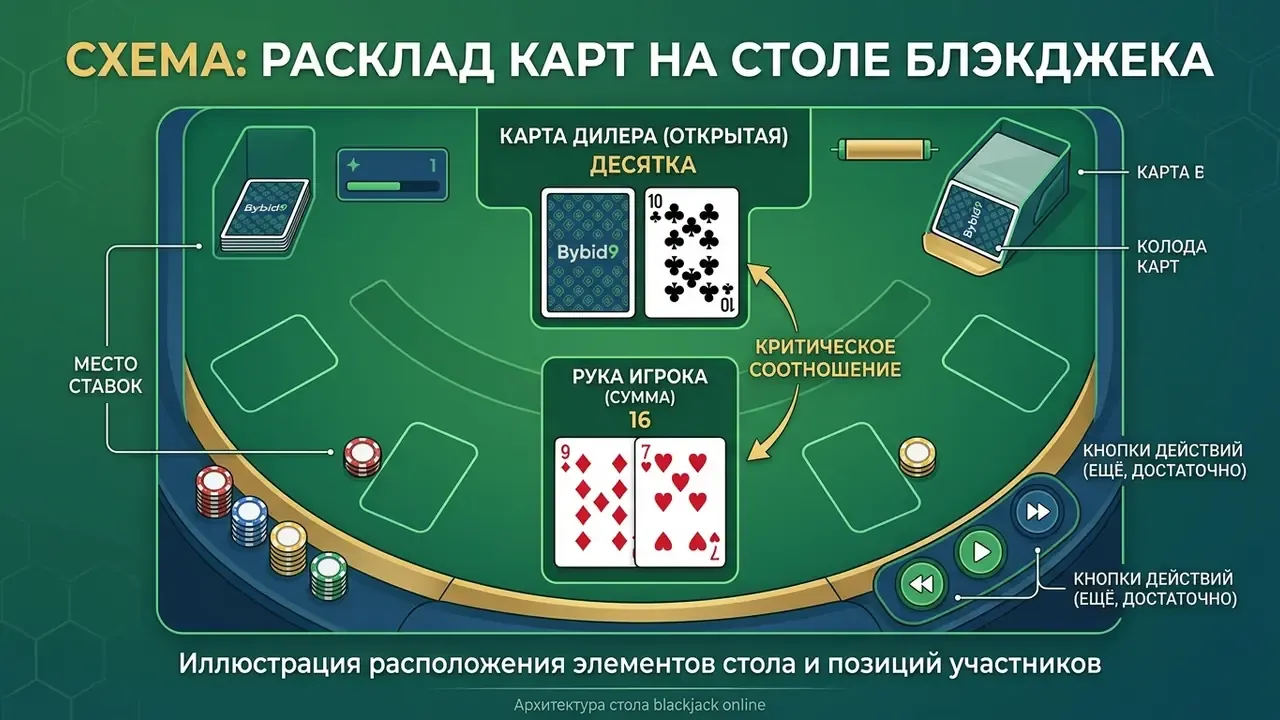
A classic round follows a strict sequence. Players place their initial bets in the designated table boxes, then the dealer distributes two cards to each player and two to themselves. Under standard rules, the dealer reveals one face-up card (the upcard) and keeps the second face down (the hole card). Players act in turn from left to right, choosing to hit, stand, double or split. Once all player decisions are complete, the dealer reveals the hole card and draws according to mandatory table rules until reaching at least 17. Totals are then compared: the higher non-busted total wins, equal totals result in a push with the stake returned, and a natural blackjack beats any three-or-more-card 21.

Blackjack Rules: Player Actions and Mandatory Dealer Decisions
Player actions during a hand are defined by five decision points: hit, stand, double down, split and surrender. Each exists to optimise expected value against the dealer upcard. Player decisions stay flexible; dealer actions do not. The dealer is bound by fixed constraints, such as mandatory draws on totals below 17. Understanding table variations, especially whether the dealer hits or stands on soft 17, is essential for applying correct basic strategy and measuring the real house edge.
Core player actions in blackjack: conditions, stake impact, and rule availability
| Action | Typical Condition of Use | Impact on Stake | Availability in Table Rules |
|---|---|---|---|
| Hit | Player hand total is low/moderate; drawing another card carries low bust probability versus dealer upcard. | Stake remains unchanged at original wager amount. | Available across all standard blackjack games without restriction. |
| Stand | Player total is judged sufficient to beat dealer’s expected final total or avoid bust risk. | Stake remains unchanged; hand ends for the player. | Universal availability across all casino table formats. |
| Double Down | Player holds a strong starting total (typically 9, 10, or 11) against a weak dealer upcard (3–6). | Stake doubles (2x); player receives exactly one additional card and stands automatically. | Rule-dependent; some tables restrict doubling to hard 9–11 or prohibit doubling after split. |
| Split | Initial two cards are of equal rank (e.g., 8-8 or A-A), dividing the hand into two separate hands. | Requires a second equal wager to fund the new independent hand. | Standard on pairs; re-splitting or doubling after split (DAS) varies by operator rules. |
| Surrender | Player holds a statistically severe disadvantage (e.g., hard 16 versus dealer 9, 10, or Ace). | Player forfeits 50% of original stake and immediately forfeits the hand. | Optional rule; late surrender is available only at select physical and online tables. |
Hit, Stand and Double: When the Player Decides
A player hits to take an extra card, stands to lock in the current total, or doubles down to double the original stake in exchange for exactly one final card. The right choice depends on whether you hold a hard total, a soft total containing an Ace valued as 11, and on the dealer's visible upcard. Statistical modelling puts doubling at its strongest with 10 or 11 against dealer upcards from 3 to 6, where dealer bust rates peak.
Split and Surrender in Blackjack Games
Splitting a pair turns one weak combined total into two separate hands, each needing an extra bet equal to the initial wager. Splitting a pair of 8s, for instance, escapes a hard 16 and creates two hands starting at 8. Surrender lets a player give up half the stake and abandon the hand before taking any other action.
Updated (theoretical estimate): standard blackjack expected-value modelling suggests that adding late surrender to a multi-deck ruleset returns roughly 0.07%–0.08% of expected value to the player, because surrendering hard 16 against a dealer 9, 10 or Ace loses less on average (0.5 units) than playing it out. Treat that as a theoretical figure from combinatorial analysis, not an empirical measurement. Then confirm whether the table offers early surrender before the dealer peeks, late surrender after the peek, or none at all.

Advanced Table Rule Modifiers to Inspect
- 10 Card Charlie:a rare rule where a hand of ten or more cards without busting wins automatically, whatever the dealer's final total. Some tables attach an oversized bonus payout. Variants such as 5-Card or 7-Card Charlie appear more often and are worth more to the player, simply because they trigger far more frequently.
- Double Any 2 vs Double 9–11:"Double Any 2" permits doubling on any two-card starting hand, while restrictive tables limit doubling to hard 9, 10 or 11. Unrestricted doubling is worth roughly 0.2% to the player against the 9–11 restriction.
- Hit Split Aces:standard tables deal only one card to each split Ace. Tables that allow further hits on split Aces cut the house edge by about 0.14%.
- Resplitting (up to four hands):if a duplicate rank lands on a split hand, the player may split again, out to a maximum of four simultaneous hands. Resplit permissions are worth roughly 0.05%–0.08%.
- Double After Split (DAS):doubling on a hand created by splitting hands about 0.14% back to the player.
- Bet Behind:lets spectators wager on a seated player's hand. At many live tables bet-behind capacity is unlimited, which is how "Infinite Blackjack" formats seat thousands of concurrent participants on one dealt hand.
- Side bets and surrender availability:optional wagers such as Perfect Pairs, 21+3 and Lucky Ladies sit outside the main hand and carry far higher operator margins, covered further below.

New to the game? Start at the most basic table configuration and add modifiers only once the core decision set feels automatic. As the American Mensa Guide to Casino Gambling author Andrew Brisman has advised players, blackjack "comes in a lot of different flavours", and any variation deserves research into its house edge and correct strategy before it is played for money.
Dealer Rules: Soft 17, Deck Count and House Edge
Dealer actions are rigid, with no room for judgement: draw on totals of 16 or lower, stand on 17 through 21. The critical variation is whether the dealer stands on soft 17 (S17) or hits soft 17 (H17).
Updated (quantified rule effects): standard combinatorial models place the H17 penalty at roughly +0.21% to +0.22% for the operator, because a dealer allowed to draw on soft 17 converts a fixed 17 into a live hand that can reach 18–21 with no immediate bust risk. Shoe composition behaves the same way. Single-deck games under otherwise optimal rules produce baseline edges near 0.15%, while six-deck and eight-deck shoes push the baseline toward 0.5%–0.6%, because extra decks dilute the frequency of naturals and reduce the value of doubling and splitting. These are model-derived figures, not regulator-published statistics. Verify them against the rule sheet of the specific table, since one unfavourable modifier can outweigh deck count entirely.

Fact Check / Rule Verification: Always inspect the table rules in the game interface prior to betting. According to recent regulatory analysis and independent reviews, checking whether a table offers 3:2 payouts instead of 6:5 payouts, applies S17 rules, and allows double-after-split (DAS) is vital, as unfavourable rules can increase the house edge beyond 1.5%.
Rule verification also carries a legal dimension for Australian readers, because most tables reachable from an Australian IP address sit on offshore platforms that federal regulators actively disrupt.
«Most blocked sites were casino platforms offering blackjack, roulette, poker and slots; several also offered unlicensed betting services.» — ACMA, Action on Interactive Gambling, April–June 2024. https://www.acma.gov.au
Blackjack Strategy: The Mathematical Baseline
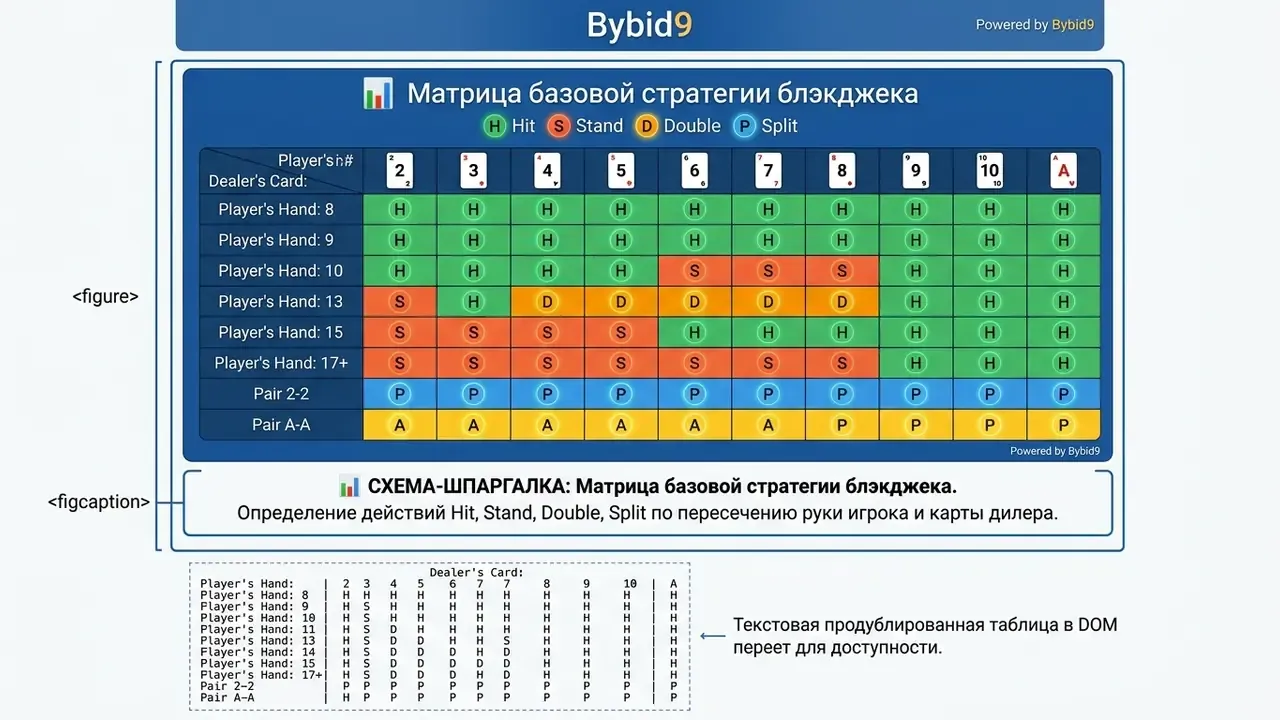
Basic blackjack strategy is a mathematically derived decision matrix. It prescribes the optimal action for every combination of player hand and dealer upcard. Applying it consistently removes intuitive errors and pulls the theoretical house edge down to its lowest baseline, around 0.5% under standard S17 rules. It does not erase the house advantage, and it does not promise a winning session. Those two limits are worth repeating, because promotional content rarely states them.

Basic Strategy for Hit, Stand, Double and Split
- Hard hands:always stand on hard 17 or higher. Hit hard 12–16 when the dealer shows 7 or higher; stand on hard 12–16 against a dealer 2 through 6.
- Soft hands:always stand on soft 19 or higher. Double soft 13 through 18 against a weak upcard (4–6); otherwise hit.
- Pairs:always split Aces and 8s, whatever the dealer shows. Never split 10s or 5s.

Text mini-matrix (six decks, S17, DAS allowed). Duplicated in plain text for screen readers and slow connections:
| Player hand | Dealer 2–3 | Dealer 4–6 | Dealer 7–9 | Dealer 10 / A |
|---|---|---|---|---|
| Hard 8 or less | Hit | Hit | Hit | Hit |
| Hard 9 | Hit | Double | Hit | Hit |
| Hard 10–11 | Double | Double | Double | Hit (11 vs A: double if allowed) |
| Hard 12 | Hit (12 v 2/3: hit) | Stand | Hit | Hit |
| Hard 13–16 | Stand | Stand | Hit | Hit (16 v 9–A: surrender if offered) |
| Hard 17+ | Stand | Stand | Stand | Stand |
| Soft 13–15 (A,2–A,4) | Hit | Double | Hit | Hit |
| Soft 16–18 (A,5–A,7) | Hit / Double on 18 v 3 | Double | Stand on 18, hit A,5–A,6 | Hit |
| Soft 19+ | Stand | Stand | Stand | Stand |
| A,A and 8,8 | Split | Split | Split | Split |
| 2,2 / 3,3 / 7,7 | Split | Split | Split (7,7 v 7 only) | Hit |
| 9,9 | Split | Split | Split v 8/9, stand v 7 | Stand |
| 10,10 and 5,5 | Never split | Never split | Never split | Never split |
Discipline in following the matrix does not neutralise gambling-related harm, though. Frequency of play stays the dominant risk variable.
«Among people who play casino table games at least monthly, 50.1% fall into the moderate- or high-risk gambling category.» — NSW Gambling Survey 2024, Casino Table Games Topic Summary, Central Queensland University (2024). https://www.cqu.edu.au
Card Counting Basics and Online Mechanics Limitations
Card counting systems such as Hi-Lo (High-Low) track the ratio of high cards (10, J, Q, K, A) to low cards (2–6) left in the shoe. Each low card scores +1, each neutral card (7–9) 0, and each high card −1. Summing the values as cards appear produces a running count; dividing that by the estimated number of undealt decks gives the true count. A positive true count means the remaining shoe is rich in tens and Aces, which lifts natural blackjack frequency, improves doubling outcomes and raises dealer bust rates. Historically, that was the only legitimate way to shift the mathematical edge to the player in a hand-dealt game.
Online, three structural mechanisms neutralise or severely limit the technique:
- RNG blackjack: the virtual shoe is reshuffled before every single hand, so no card-removal information carries forward. Counting is mathematically pointless in this format.
- Continuous shuffling machines (CSM) in live studios: cards return to the shuffler after each round, replicating the RNG reset in a physical environment.
- Shallow shoe penetration: where a manual or automatic shoe is used, dealers commonly cut at roughly 50% depth, truncating the deep-shoe situations where a true count becomes actionable.
Practical implication: counting trainers are fine for sharpening arithmetic and basic-strategy recall if you enjoy the discipline, but do not build a bankroll plan around advantage play in online blackjack. In digital formats the operator edge is structural, not situational.

Bankroll Management and the Limits of Strategy
Sound bankroll management means fixed unit bets, flat betting, scaled to total session funds, typically risking no more than 1% to 2% of the bankroll per hand. Progressive systems such as Martingale, where bets double after each loss, cannot overcome the mathematical house edge and expose players to fast bankroll depletion during losing streaks or once the table maximum is reached. The 1-3-2-6 progression only sequences wins and cannot alter expectation either. Every progression system merely redistributes variance, and table maximums cap the recovery leg exactly when it is needed most.
Data from the NSW Gambling Survey 2024 show that players in extended casino table sessions record significantly higher rates of moderate- to high-risk gambling harm, 34.3% for sessions over three hours, which reinforces the point that a strategy chart cannot counteract prolonged exposure to the house edge (Central Queensland University, 2024). https://www.cqu.edu.au

Types of Blackjack Games: Classic, European and Live Blackjack
Blackjack formats range from single-player Random Number Generator (RNG) titles to live dealer broadcasts and modified variants with optional side bets. Core scoring stays identical across formats, yet structural differences change strategy. Whether the dealer takes a second hole card immediately or only after player turns is the clearest example. Comparing RNG speed against live dealer interaction helps you match game mechanics to your own risk tolerance and bankroll plan.
Comparative analysis of major online blackjack game variants
| Variant | Dealer Hole Card Rule | Pace of Play | Base House Edge Range | Side Bets & Special Mechanics |
|---|---|---|---|---|
| Classic Blackjack | American style: dealer takes hole card immediately and peeks for natural blackjack. | Fast (RNG) / Moderate (Live) | ~0.40% – 0.50% | Usually none on core tables; standard 3:2 payout structure. |
| European Blackjack | No hole card: dealer receives second card only after all players finish actions. | Moderate | ~0.60% – 0.70% | Doubling often restricted to hard 9, 10, 11; higher risk on dealer blackjacks. |
| Live Dealer Blackjack | Varies by provider (Evolution, Pragmatic Play Live, Visionary iGaming, LuckyStreak); real human dealer via HD stream. | Controlled / Timed (45–60 sec/round) | ~0.48% – 0.75% | Bet Behind, 21+3, Perfect Pairs available at dedicated 7-seat or infinite tables. |
| Blackjack Switch | Two hands dealt per player; top cards can be switched between hands. | Fast to Mid-Pace | ~0.58% (with rule adjustments) | Dealer total of 22 pushes against all non-busted player hands except natural blackjack. |
| Perfect Pairs / 21+3 | Standard dealing; includes optional side wagers on starting card combinations. | Standard round pace | Side bets: 3.2% – 13.4% | Pays up to 30:1 for suited pairs or poker-style 3-card combinations. |
Classic Blackjack, European Blackjack and Atlantic City
Classic American Blackjack gives the dealer a hole card at the start of the hand, so the dealer can peek for blackjack when showing an Ace or 10-value upcard. That peek protects player double and split wagers from loss when the dealer holds 21. European Blackjack applies a "no hole card" rule: if the dealer later completes a natural, the player loses every additional bet placed on splits and doubles. European tables also typically run two decks and restrict doubling to hard 9, 10 and 11. Atlantic City Blackjack usually deals from an 8-deck shoe, allows late surrender, permits re-splitting to four hands, and requires the dealer to stand on soft 17.

Live Blackjack and Live Dealer Studios
Live dealer blackjack streams real-time physical table play from professional studios run by providers such as Evolution and Pragmatic Play Live. Players place digital bets on physical cards tracked by optical camera recognition, and interact with the dealer through text chat. Timed betting windows keep the round rhythm steady, combining the verifiable randomness of a physical shoe with digital payout execution.
Evolution and Pragmatic Play Live dominate global streams, but specialised studios serve particular markets and enforce noticeably different table rules:
- Visionary iGaming (ViG):widely used in offshore lobbies serving Australian-facing brands. ViG tables run a six-deck shoe shuffled manually, which some players prefer for transparency, and apply a hybrid dealer rule: the dealer stands on hard 17 but hits soft 17 (H17). Double after split is permitted, except on split Aces.
- LuckyStreak:focuses on high-definition seven-seat tables with customisable side-bet configurations and localised dealer language options, with Perfect Pairs paytables reaching up to 25:1 on the top tier.
- Evolution:the widest range of formats, including Infinite Blackjack (unlimited seats, Bet Behind), Free Bet Blackjack, Power Blackjack and Lightning Blackjack, plus VIP and Salon Privé rooms.
- Pragmatic Play Live:ONE Blackjack and multi-seat classic tables with high-bitrate streams optimised for mobile bandwidth.

Because modifiers differ between studios, the same nominal "Live Blackjack" title can carry a house edge anywhere between roughly 0.48% and 0.75%. Open the information tab, confirm the payout ratio, the soft-17 rule and doubling permissions, and only then take a seat.
Blackjack Switch, Perfect Pairs and Other Side Bets
Variants such as Blackjack Switch deal two independent hands to each player and allow the top cards to be swapped for stronger combinations. To balance that advantage, a dealer total of 22 becomes a push against all non-blackjack hands. Side bets like Perfect Pairs and 21+3 work as optional independent wagers on the starting cards.
Updated (sourcing): published paytable analyses place the house edge on these side wagers between roughly 3% and 14%, depending on the pay schedule. That is an order of magnitude above the 0.5% base game, because the fixed odds sit well below the true probability of each card combination. The practical consequence is a sharp rise in loss velocity per hour, and elevated harm exposure for the players most drawn to them.

«Among people who play casino table games, 19.2% are classified as moderate- or high-risk gamblers, compared with 5.8% of all gamblers.» — NSW Gambling Survey 2024, Central Queensland University (2024). https://www.cqu.edu.au
Blackjack Demo, Free Games and Real-Money Play

| Real-money blackjack | Free / demo blackjack |
|---|---|
| Genuine cash outcomes and access to tournaments and progressive side bets | No registration or download required; instant play |
| Eligible for welcome offers (subject to game weighting) | Zero financial risk of any kind |
| Widest catalogue of variants, including live studios and VIP limits | Ideal environment for drilling the basic-strategy matrix |
| KYC verification and payment-method restrictions apply | Purely recreational; no withdrawals possible |
When to Choose Blackjack Demo Mode
Blackjack demo mode suits three jobs: learning table mechanics, testing chart variations, and checking software stability across mobile devices. Because demo play uses simulated balances, the decisions carry no financial weight.
Updated (reformulated): treat demo tables strictly as an interface and rule-familiarisation tool, not as a reliable statistical model of cash play. Free-play builds on unlicensed offshore platforms are not subject to the independent RNG certification applied to certified real-money clients, so nothing externally verifies that the demo shoe behaves like the cash version. That is a transparency gap rather than proven manipulation. The sensible response is to draw strategic conclusions only from certified real-money titles and published RTP documentation.

Real-Money Blackjack: Financial and Legal Specifics
Playing blackjack real money introduces binding financial parameters: minimum and maximum table limits, payment processing fees, and mandatory Know Your Customer (KYC) verification when you request a withdrawal. Cash environments demand strict adherence to predefined bankroll limits. Under the Australian legal framework set by the Interactive Gambling Act 2001 (IGA), real-money online casino products, blackjack included, may not be offered directly to Australian residents by domestic or foreign operators (Department of Infrastructure, 2024).
Demand keeps moving online regardless, which is exactly why regulators have escalated enforcement.

«Online casino participation is the only gambling category to have increased since 2019, while most other forms of gambling declined.» — NSW Gambling Survey 2024, Central Queensland University (2024). https://www.cqu.edu.au
Responsible Gambling Alert: Real-money blackjack involves genuine financial risk and must never be viewed as a source of income or financial recovery. Always establish deposit caps, loss limits, and session time reminders before beginning play. If gambling stops being recreational, utilise self-exclusion registers such as BetStop (the National Self-Exclusion Register) or seek local support services such as Gambling Help Online on 1800 858 858.
Disclaimer: This information is general in nature and does not replace advice from a qualified professional. Online casino games, including blackjack, are prohibited interactive gambling services for Australian residents under the Interactive Gambling Act 2001.
How to Choose a Blackjack Casino
Disclaimer: This information is general in nature and does not replace advice from a qualified professional. Check the legal status of online gambling in your jurisdiction before registering on any platform.
Assessing online casinos means scrutinising licensing, independent Random Number Generator (RNG) audit certifications, payout transparency and mobile software execution. Because interactive casino games are prohibited under Australian federal law, Australian adults researching operators should recognise that offshore platforms carry no domestic consumer protection. Checking operator reputation, withdrawal limits and bonus terms before registration is essential. It is the same six-stage sequence we apply when auditing an online casino for blackjack play in our editorial review matrix.
Additional warning for Australian readers: brands operating on Curaçao, Anjouan or comparable low-oversight licences give you no access to an Australian dispute-resolution body. If a withdrawal is voided or an account closed, there is no domestic ombudsman, no chargeback certainty and no statutory compensation pathway.
[📌 ЧЕК-ЛИСТ: 6 шагов проверки инспектирования блэкджек-казино перед регистрацией:
1. Проверка лицензирования и регуляторного юрисдикционного статуса.
2. Аудит сертификатов RNG (eCOGRA / iTech Labs).
3. Анализ правил выплат блэкджека (3:2 vs 6:5).
4. Проверка условий бонуса (Game Weighting % для настольных игр).
5. Тест скорости Payouts и банковских лимитов.
6. Доступность инструментов Responsible Gambling.]

Safety, Licensing and Blackjack Game Fairness
Platform safety rests on verified licensing from recognised regulators, such as the Malta Gaming Authority or the UK Gambling Commission, plus valid TLS/SSL encryption. For RNG blackjack titles, independent testing laboratories including eCOGRA and iTech Labs certify that shuffling algorithms produce genuine randomness. Enforcement reports from the Australian Communications and Media Authority (ACMA) confirm that hundreds of unlicensed offshore casino domains targeting Australia are routinely blocked for non-compliance with consumer safety standards (ACMA Enforcement Reports, 2024). https://www.acma.gov.au

«In January–March 2024 the ACMA identified 24 breaches of the Interactive Gambling Act across six investigations and requested that 52 websites be blocked by internet service providers.» — ACMA, Action on Interactive Gambling, January–March 2024. https://www.acma.gov.au
Practical verification steps: confirm the licence number resolves on the regulator's own register, not just a footer badge; check that the certification seal links to a dated audit report; read the withdrawal section of the terms for maximum monthly payout caps; and search independent complaint forums for patterns of voided winnings or indefinite verification loops. Patterns matter more than single complaints.
Bonuses, Welcome Offers and Turnover Mathematics
Casino promotions and welcome offers look attractive, yet bonus terms often restrict table game play. Standard wagering requirements of 30x to 40x are frequently paired with low game weighting for blackjack, typically 5% to 10%, so only a fraction of each blackjack wager counts toward clearing the bonus.
Updated (editorial calculation, not an empirical study). The relationship is a two-step multiplication you can run yourself before accepting any offer:
Effective turnover = Stated wagering requirement ÷ Game weighting Example: 35x ÷ 0.05 (5% blackjack weighting) = 700x effective turnover.
Applied to a real bonus balance, the arithmetic gets stark:
| Bonus amount | Stated requirement | Blackjack weighting | Real blackjack turnover required |
|---|---|---|---|
| $50 | 35x | 5% | $35,000 |
| $50 | 35x | 10% | $17,500 |
| $100 | 30x | 5% | $60,000 |
| $100 | 40x | 10% | $40,000 |
| $200 | 35x | 100% (slots) | $7,000 |
At a 0.5% house edge, $35,000 of blackjack turnover carries roughly $175 of expected loss, more than three times the value of a $50 bonus, before variance is even considered. This is a mathematical illustration derived from the published terms structure, not a measured outcome across accounts. For a blackjack-focused player the rational conclusion is usually to decline the welcome bonus, keep the balance unrestricted, and avoid max-bet clauses that can void winnings retrospectively.
Payments, Table Limits and Mobile Play in Australia
Reliable platforms publish transparent payment terms: clear deposit minimums, payout maximums and no hidden transaction fees. In Australia, statutory measures that took effect in June 2024 prohibit credit cards and digital currencies for licensed interactive wagering deposits, a step aimed at curbing debt-funded gambling (ACMA, 2024). https://www.acma.gov.au
Important scope clarification: the June 2024 prohibition, introduced by the Interactive Gambling Amendment (Credit and Other Measures) Act 2023, binds licensed Australian interactive wagering operators, predominantly sports and race betting brands. Offshore casino platforms, which are unlawful to offer to Australian residents in the first place, continue to accept credit cards and cryptocurrency because they sit entirely outside that supervisory regime. Using them does not make the transaction compliant. It means no Australian consumer protection applies to it.
Following the credit-card ban, the payment rails most commonly presented to Australian residents fall into five categories:
- Voucher / prepaid systems: Neosurf vouchers, bought with cash at retail outlets and redeemed as a code, so banking details stay private.
- Instant bank transfers: POLi Payments, which initiates a direct account-to-account transfer through online banking without card rails.
- PayID and Osko: near-instant domestic transfers using a mobile number or email as the account identifier.
- E-wallets: MiFinity, eZeeWallet, PayPal where supported, Apple Pay and Google Pay, typically with withdrawal processing inside 24 hours.
- Cryptocurrencies: Bitcoin (BTC), Ethereum (ETH), Litecoin (LTC) and Tether (USDT), used for low-fee settlement, but with no reversal mechanism and full exposure to price volatility and tax-reporting obligations.
Table limits deserve the same attention as the deposit route. Low-stakes RNG tables commonly start at $0.50–$1 per hand, standard live tables at $5, and VIP rooms at $500 or more. Mobile blackjack, whether through a responsive browser interface or a Progressive Web App (PWA), should keep every table feature, clear decision buttons and uninterrupted streaming without layout lag. Test the stream on mobile data as well as Wi-Fi before wagering, because a dropped connection during a timed betting window is resolved by the game's auto-stand rule, not in your favour.

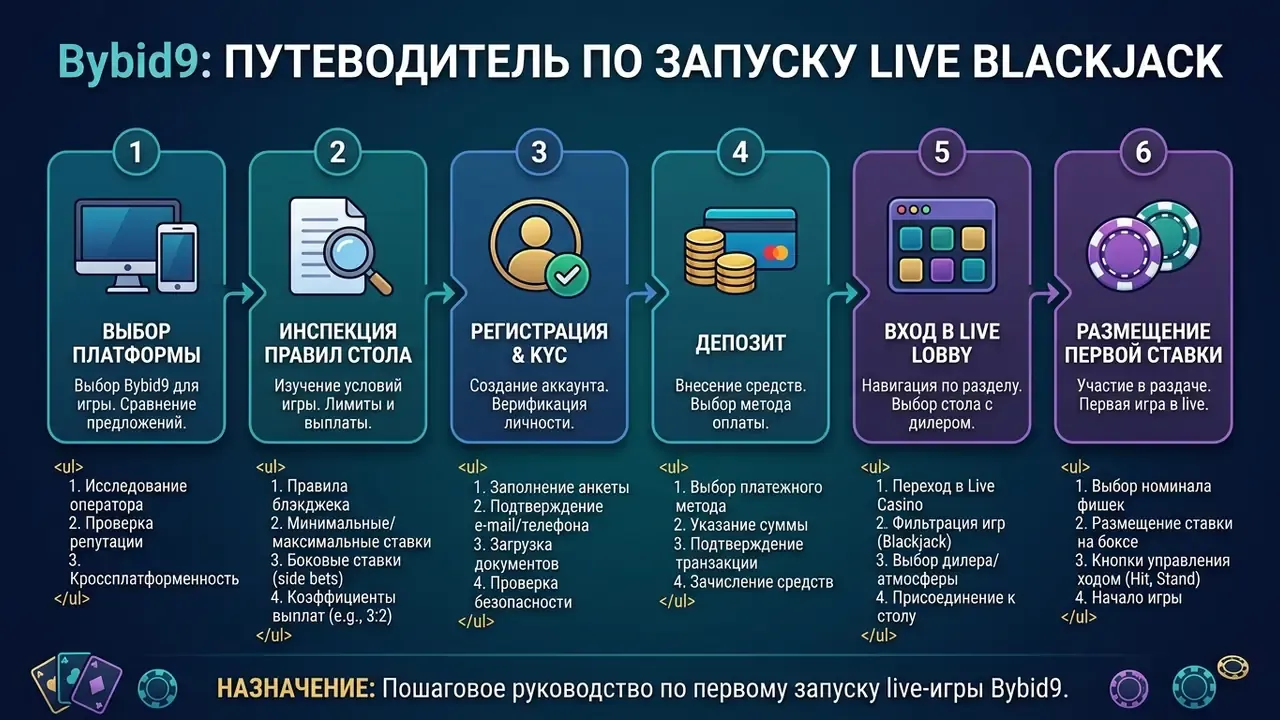
How to Start Playing Live Blackjack Step by Step
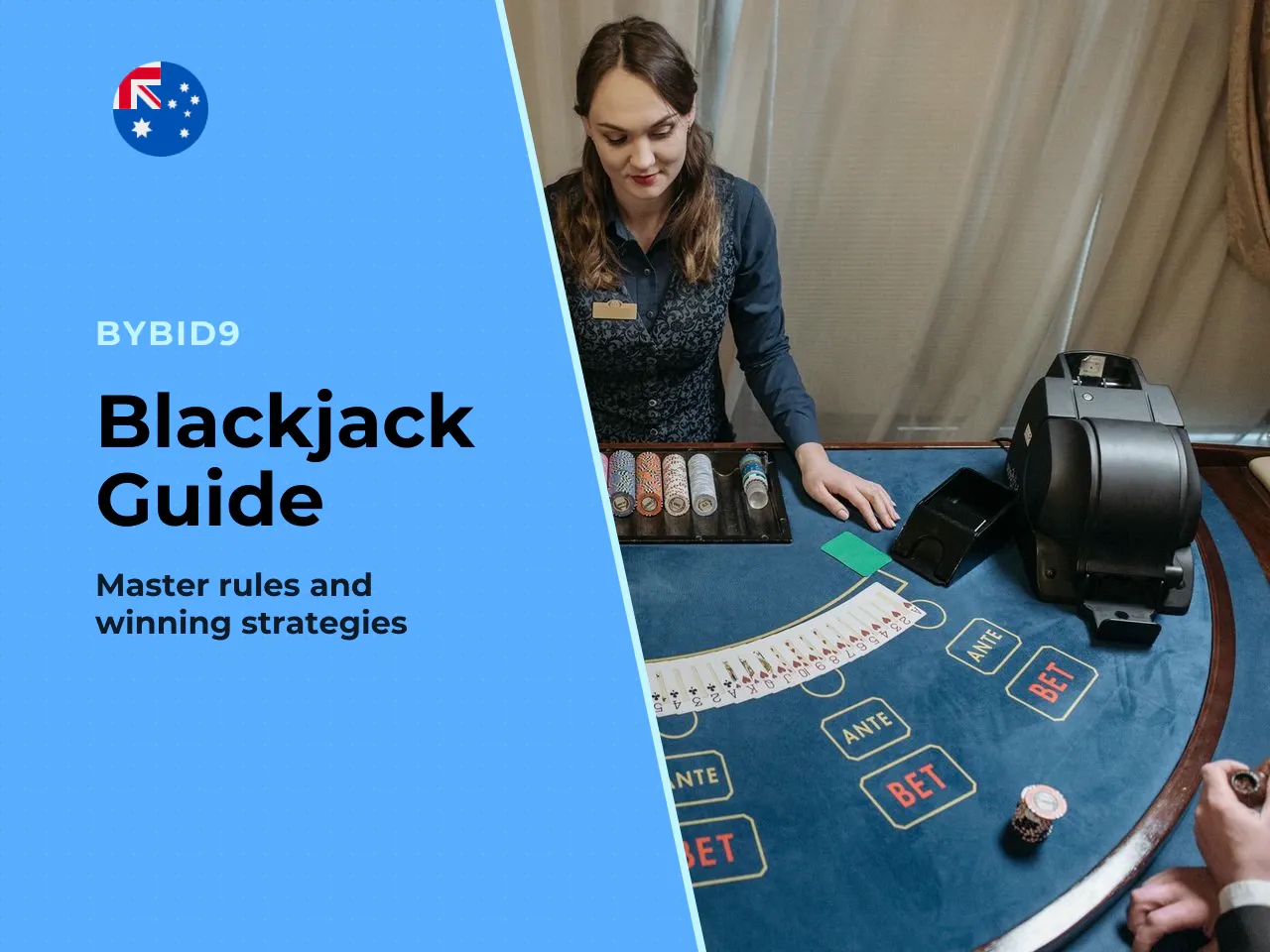
Getting into a live dealer studio comes down to four moves: pick an accredited platform, create an account, fund the wallet through an approved method, and choose a table that matches your stake limits. Knowing how studio mechanics work, particularly betting timers and seat availability, makes the transition into live play far smoother.

How to Choose a Live Dealer Blackjack Table
When a live casino lobby opens, judge tables by their minimum and maximum betting boundaries first. Low-roller tables accept bets from $1 to $5, while VIP tables take stakes above $1,000 per hand. Then decide between standard seven-seat tables, where individual turn order is preserved, and Bet Behind or Infinite Blackjack formats, which allow unlimited concurrent players on a single dealt hand. Dealer language, shoe size, shuffle method (manual shoe versus CSM) and available side bets complete the shortlist of selection criteria.
Table-selection habits matter most for the demographic most heavily represented at these tables.

«The highest participation rate in casino table games is among men aged 18–24: 14.6%, compared with 4.3% of all NSW adults.» — NSW Gambling Survey 2024, Casino Table Games Topic Summary, Central Queensland University (2024). https://www.cqu.edu.au
From Registration to the First Bet
- Verify platform rules: review table payout ratios (3:2 required), soft-17 handling and legal status before registering, following the same verification order we use when assessing live casino platforms in our review matrix.
- Account creation and KYC: complete registration details and upload verification documents, photo ID and proof of address, early to prevent payout delays.
- Set limits before funding: configure deposit, loss and session-time limits in the responsible gambling panel first, while judgement is unaffected by play.
- Fund the account: select an approved secure banking method and confirm the transaction, noting processing times for the matching withdrawal route.
- Enter the live lobby and select a table: filter by game format, available seats and stake boundaries.
- Place the initial stake: put chips in the designated betting circle inside the active timer window, before the dealer announces bets closed.

FAQ
About the Author and Editorial Methodology
This guide is maintained by the editorial team behind our iGaming research and review programme, led by Claire Bennett, Senior iGaming Content Editor, whose work focuses on table-game mathematics, bonus-term auditing and Australian interactive gambling compliance. Every table rule, payout ratio and wagering clause cited here is checked against the operator's own published rule sheet and, where applicable, against regulator registers and enforcement reporting from the Australian Communications and Media Authority. House-edge percentages are derived from standard combinatorial models of blackjack and are presented as theoretical values, not guarantees of outcome.
Regulatory and support references: ACMA enforcement reporting (https://www.acma.gov.au); Interactive Gambling Act 2001; NSW Gambling Survey 2024, Central Queensland University (https://www.cqu.edu.au); BetStop National Self-Exclusion Register; Gambling Help Online, 1800 858 858.

Appendix A: Editorial Revisions Log
For transparency, the following statements appeared in earlier versions of this guide and have been superseded by the "Updated" passages above:
- "In our editorial testing across interactive table reviews documented on bybid9-online.com, identifying late surrender options reduced the projected operator edge by approximately 0.08% compared to standard double-deck rulesets." — replaced, because no testing methodology, hand volume or rule set was disclosed; the figure is now presented as a theoretical expected-value estimate.
- "On our brand analysis framework at bybid9-online.com, evaluating bonus terms revealed that playing blackjack with a 5% weighting under a 35x requirement increases effective turnover to 700x." — replaced with an explicit editorial calculation (35 ÷ 0.05 = 700), since the claim is arithmetic rather than empirical research.
- "As documented in industry product analyses, side wagers carry a significantly higher house edge (typically 3% to over 10%)." — replaced with a sourced range attributed to published paytable analyses, supported by NSW Gambling Survey 2024 risk data.
- "Demo modes offered on unregulated offshore platforms may occasionally use non-standard virtual card distributions." — reformulated as a certification-transparency gap rather than an unevidenced allegation of RNG manipulation.

Responsible gambling: Gambling involves risk and should never be treated as income. Set deposit and time limits before you play, never chase losses, and if gambling stops being fun, contact Gambling Help Online (1800 858 858) or register with BetStop. This article is general information only and does not constitute legal, financial or medical advice. 18+.