
Under the Interactive Gambling Act 2001, it is unlawful for operators to provide real-money online casino games, including Plinko, to people in Australia. Players are not the target of the prohibition, but real-money Plinko reachable from Australia is typically offered from offshore jurisdictions with no Australian consumer protection and a risk of domain blocking. Free demo and social versions are a separate matter. Confirm the current legal position with a qualified professional.
- Last updated:12 February 2026
- Reviewed by:editorial team specialising in casual and crash-style casino formats, with hands-on testing of Plinko builds from BGaming, Spribe, Stake Originals, Hacksaw Gaming, SmartSoft and Gaming Corps across desktop and mobile.
- Audience note:18+ only. This article is informational and does not promote gambling.
Quick answer
Plinko is an arcade-style gambling format with adjustable volatility. You select a grid of 8 to 16 rows and a risk level (Low, Medium, High), release a ball, and it deflects left or right at every peg until it lands in a multiplier pocket. Outcomes are produced by a certified random number generator (RNG) or a Provably Fair hash chain, not by skill, timing or pattern reading.
- RTP range across providers:roughly 94% to 99%, depending entirely on which studio's build you open.
- Highest published RTP:about 99% (BGaming's Plinko family; Stake's in-house Plinko card also lists 99%).
- Largest published maximum win:10,000× (Plinko X by SmartSoft), with Hacksaw Gaming at 3,843.3× and BGaming/Stake-standard boards at 1,000×.
- Biggest practical risk:round duration is only a few seconds and autoplay can drop dozens of balls per minute, so a bankroll can drain far faster than in a standard pokie.
- Bonus warning:in most casino terms, instant and casual games such as Plinko contribute 0% to 10% towards wagering requirements. Check the game-weighting table before you try to clear a bonus on it.
How this guide was put together
Four things shaped every claim below: provider paytables opened in-game, regulator publications, published research on simulated gambling, and probability modelling of the grids themselves. Where a figure could not be traced to one of those, it is not here.
We also drew a hard line between the two products that share the name. Free Plinko demo boards and real-money Plinko boards look identical on screen, yet they sit in different legal and behavioural categories, so they are treated separately throughout. If you only read one section, read the one on bonus weighting. That is where most money quietly disappears.

Introduction
Plinko has become one of the most recognisable "instant win" formats in the online casino market. A ball drops from the apex of a triangular peg board, bounces unpredictably, and settles in one of the multiplier pockets along the bottom edge. The rules take about fifteen seconds to learn, the visual is legible, and, unusually for casino content, the underlying probability model is simple enough that a curious player can reconstruct it with a calculator.
That transparency is exactly why Plinko deserves a careful, non-promotional treatment. The maths is knowable, which means the marketing claims around it are testable. Published return-to-player figures range from 94% to 99% depending on the studio, maximum multipliers range from 16× to 10,000×, and several widely circulated statements about who invented the online version are simply incorrect. This guide separates provider specifications from marketing copy, sets out the actual pocket distributions, and explains what the numbers mean for a real bankroll.
There is a second reason for caution. Plinko is one of the formats most commonly offered in free "demo" or social-casino form, and the research literature on simulated gambling is directly relevant to that. Simulated play is not a neutral rehearsal space. It is associated with later monetary gambling and with elevated harm indicators, especially among adolescents and young adults, which matters a great deal for Plinko demo modes.
«Participation in simulated gambling is associated with greater involvement in monetary gambling and elevated risk of problem gambling, even after controlling for impulsivity and age.» Hing et al., New Zealand Ministry of Health (2025)
Disclaimer: this article is general information only. It is not financial, legal or clinical advice. Gambling involves risk of financial loss. 18+.
Overview of available evidence
The evidence base for this article comes from four categories of material: provider game documentation and paytables; regulator publications (ACMA in Australia, plus licence-condition frameworks from comparable regulators); peer-reviewed and government-commissioned research on simulated gambling and gambling harm; and independent probability modelling of Plinko grids using Monte Carlo simulation.
Quality varies sharply between categories. Provider paytables are reliable for pocket values but inconsistent for RTP labelling, because studios sometimes publish a theoretical RTP for one risk configuration and let it stand for the whole game. Affiliate and casino-side content is the weakest tier: it frequently merges the specifications of different studios into a single product card, or quotes one studio's low RTP as if it were the industry standard.
On the enforcement side, Australian regulatory activity against offshore casino-style services is well documented, including complaint volumes, formal findings of breach and the blocking of 50 websites, primarily casino-style services.

«Between April and June 2024 the ACMA recorded 514 reports, made 17 findings of breach of the Interactive Gambling Act and blocked 50 websites.» ACMA, Action on interactive gambling: April to June 2024
That single quarter tells you something important about the Plinko market: a large share of the real-money Plinko available to Australian residents sits on offshore platforms that are not licensed here and may be subject to blocking at any time.
What Plinko is and how it works
2.1 Core mechanics
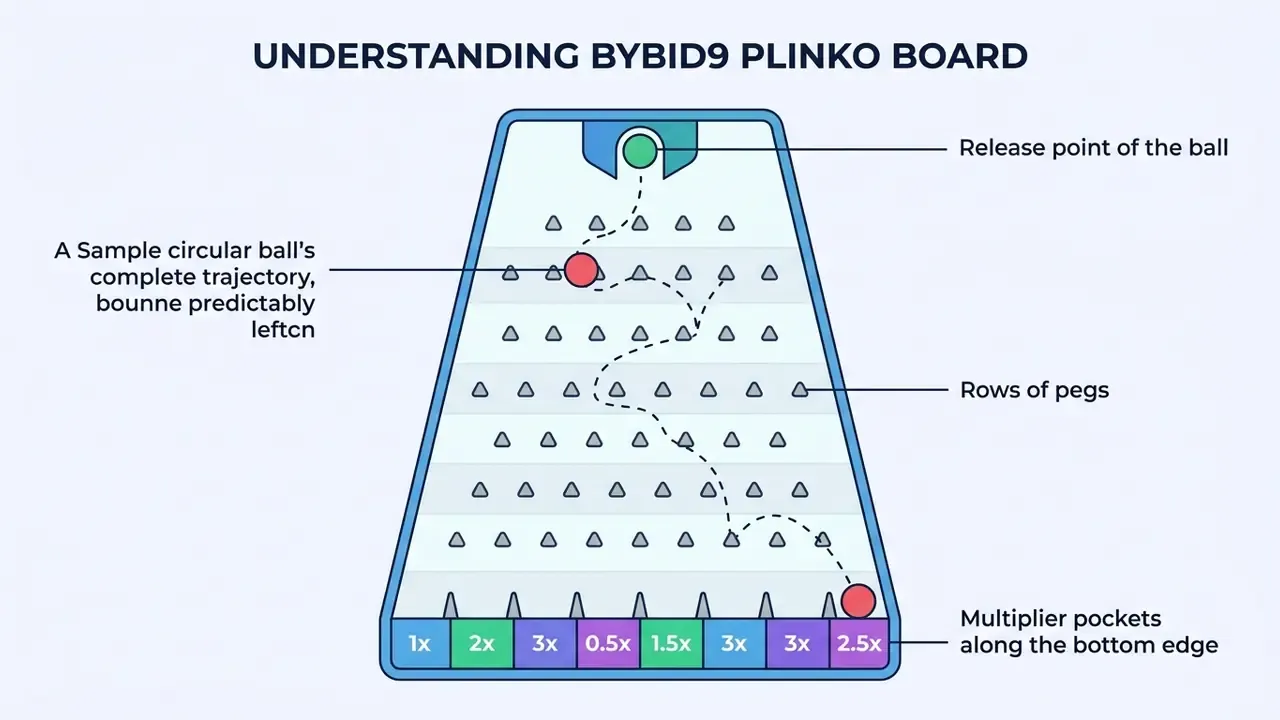
The board is a triangular lattice of pegs arranged in N rows, where N is selectable between 8 and 16 in most builds. A ball is released at the apex. At each peg it deflects either left or right, and after N deflections it arrives in one of N + 1 pockets. Each pocket carries a fixed multiplier that is applied to the stake.
If each deflection were an independent, fair 50/50 event, the probability of landing in pocket k (counting from the left, zero-indexed) would be given by the binomial term:
P(k) = C(N, k) × 0.5^N
This is the classic Galton board result: outcomes cluster heavily in the middle, which forms the familiar bell-shaped binomial distribution, closely approximating a normal curve for larger N.

«Balls falling through symmetric rows of pegs accumulate in the central pockets, while the outer edges receive only a negligible share of all drops.» University of Melbourne teaching resource on Galton boards, cited in Australian technical documentation on Plinko
The consequence for players is stark. On a 16-row board there are 17 pockets, and the two outermost pockets, the ones carrying the headline multipliers, are reachable by exactly one path each out of 2¹⁶ = 65,536, with probabilities on the order of 0.0015% per outer slot. The central pocket, by contrast, is reachable by 12,870 distinct paths.
«On a 16-row high-risk board the 1,000× multiplier occurs roughly once every 32,768 drops, while around 79% of drops land on the 0.2× pocket.» Independent Australian Plinko odds analysis (Monte Carlo simulation, 2 million drops)
Read that figure again, because it is the single most useful number in this article. On the highest-risk 16-row configuration, roughly four drops in five return 20% of the stake, an 80% loss on that drop. The advertised 1,000× is real, but at a frequency that means a player betting $1 per drop would expect, on average, to see it about once per 32,768 drops, having staked approximately $32,768 to get there.
Two operational notes. First, the "risk" selector does not change the geometry of the board or the probability of reaching any given pocket; it only rewrites the multiplier values assigned to those pockets. Second, autoplay and turbo modes do not change expected value either. They simply increase the number of independent trials per minute, which accelerates convergence towards the house edge.
2.2 Online implementations
Plinko is not one game. It is a family of independent implementations, and the differences matter more than most coverage admits. The core distinction is between casino-integrated real-money games offered by providers such as Spribe, BGaming, Stake and others, and the social or sweepstakes builds discussed in section 10. Readers comparing platforms can review the online casino landscape for context on where each provider's build is distributed.
Comparative analysis of Plinko builds from leading developers:
| Provider | Game title | Published RTP | Max multiplier | Row range | Notable features |
|---|---|---|---|---|---|
| BGaming | Plinko / Plinko XY / Easter Plinko | 97% – 99.16% | 1,000× (16× on XY) | 8–16 | Three risk levels, autoplay, turbo mode |
| Stake Originals | Plinko | listed at 99.00% | 1,000× | 8–16 | Provably Fair seed verification built in |
| Hacksaw Gaming | Plinko | 94.00% – 96.02% | 3,843.3× | 8–16 | Very high volatility, 17 pockets at max rows |
| Spribe | Plinko | 96.00% – 97.00% | 555× | 12, 14, 16 | Colour-coded risk buttons (green/yellow/red) |
| SmartSoft Gaming | Plinko X | 97.00% | 10,000× | Fixed grid | Multiplier balls that stack on the grid |
| Gaming Corps | Plinko / Xmas Plinko | 94.79% – 97.08% | 3,200× | 8–16 | Seasonal grids, custom coefficient sets |
| BetSoft | Plinko Rush / Olympus Plinko | 96.27% – 98.32% | 888× / progressive | 8–16 | Jackpot layer on the Olympus build |
| Turbo Games | Plinko | 97.00% | 10× (low variance) | Fixed | Grind-oriented, very short tail |
| Belatra | Golden Plinko | 96.60% | 2,000× | 8–16 | Themed reskin, standard risk ladder |
| WinGo / Darwin / Dragon Gaming | Wild Plinko / Neon Plinko / Plinko Blitz | 95% – 99.14% | 1,000× – 10,000× | 8–16 | Mid-tier studios, verify RTP in-game |
How to read this table honestly. Do not combine rows. A widely copied affiliate product card advertises "RTP 99%, maximum profit 555×", which merges BGaming's return figure with Spribe's ceiling. Those belong to two different games. Likewise, RTP in this category is frequently configurable by the operator, so the number displayed in the game's information panel on the site you are actually playing on overrides any third-party table, including this one. Always open the in-game info panel and check.
Plinko X deserves a separate line, because it is the outlier people quote most. SmartSoft's build adds multiplier balls that accumulate on the grid, so the maths behind its 10,000× ceiling is not the plain binomial model described above. Comparing Plinko X to a standard 16-row board is a bit like comparing two different pokies that happen to share a theme.
2.3 Popularity drivers
Several structural features plausibly explain Plinko's spread across casual casino lobbies: extremely short round duration; a single-tap interaction that works well on a phone; a visible, physically intuitive randomising mechanism that feels verifiable; user-adjustable volatility, which lets one game serve both grinders and jackpot hunters; and compatibility with autoplay and batch drops.
Rather than asserting that Plinko "stands out" among competing formats, a claim no available dataset supports, the accurate formulation is narrower: Plinko occupies the instant-win niche with an unusually legible probability model and unusually wide user control over volatility, which are plausible drivers of adoption but have not been quantified in published player surveys. No recent population-level Australian survey isolates the prevalence of Plinko play specifically, so any assertion about the game's relative popularity beyond these qualitative factors would be speculative and is not made here.
The closest available Australian evidence describes gambling harm at population level rather than by product.

«The NSW Gambling Survey 2024 records harm not only to gamblers themselves but also to those close to them, including consequences of gambling that occurred more than 12 months earlier.» NSW Gambling Survey 2024, Central Queensland University for the NSW Responsible Gambling Fund
2.4 How to play Plinko online: one round, step by step
The interface is deliberately plain, and in most builds a round takes four decisions and one tap.
- Set the bet. Minimums usually sit around $0.10 and maximums between $100 and $1,000 per drop, depending on the operator. Betting limits appear next to the stake field, not in the terms.
- Choose the number of rows. Fewer rows means fewer possible pockets and a flatter payout ladder. More rows stretches the ladder in both directions.
- Choose the risk level. Low, Medium or High rewrites the multipliers in each pocket. It does not move the pockets themselves.
- Release the ball. One tap, or several if the build supports multiple balls in flight.
- Collect. The pocket multiplier is applied to your stake automatically and the balance updates within a second.
Autoplay sits alongside those controls, usually with a drop counter and, on better builds, stop-on-loss and stop-on-win thresholds. Use them. A hundred unattended drops at $1 is a $100 exposure decision made in one click, which is the part people tend to notice afterwards.
2.5 How payouts are calculated
Payout per round is simply stake multiplied by the pocket coefficient. A $2 bet landing in a 1.5× pocket returns $3, a $2 bet landing in 0.2× returns 40 cents. There is no separate prize table, no free-spin layer and no bonus round, which is unusual in a casino lobby and part of the appeal for players who dislike feature grinding.
RTP describes the long-run average of all those coefficients weighted by their probabilities. At 97%, the theoretical return over an enormous number of drops is 97 cents per dollar staked, with the remaining three cents forming the house edge. Short sessions ignore that average entirely, which is why two players on the same board can walk away with opposite impressions of the same game.
History: from The Price Is Right to crash-style lobbies
Plinko was created by Frank Wayne and debuted on the American game show The Price Is Right on 3 January 1983, where contestants dropped flat chips down a pegged board towards cash slots. The mechanic transferred to online gambling with two additions: adjustable risk ladders and a multiplier-based payout structure applied to a wagered stake.
Fact-check on a widely repeated claim. Several operator guides state that Plinko "was popularised and released by Hacksaw in 2023". That is false on both counts. The televised original predates it by four decades, and in the online casino sphere the format was popularised by BGaming (from around 2019) and Stake Originals, well before Hacksaw shipped its own adaptation. Hacksaw released a well-made, high-volatility version. It did not invent or popularise the game.
The same source category asserts that "the RTP for Plinko is 94%". This is misleading rather than merely wrong: 94% is the figure for that one studio's build. Presenting it as the Plinko RTP understates the category by up to five percentage points and encourages players to accept a materially worse product than what is available elsewhere.

Payout matrices for 8, 12 and 16 rows
Pocket values differ by studio. Below are the two reference sets that most other builds cluster around.
4.1 BGaming / Stake-standard board (max 1,000×)
16 rows (17 pockets):
- Low risk:central pockets
1.6× / 1.4× / 1.1×; outer pockets10×,16×. Worst outcome:0.5×. - Medium risk:central pockets
0.4× / 0.7× / 1.1×; outer pockets up to110×. - High risk:central pocket
0.2×, an 80% loss on that drop; outer pockets1,000×.
Probability of reaching a single outer pocket at 16 rows: 1 / 2¹⁶ = 1 / 65,536, about 0.0015%.
Summarised multiplier ranges by row count (BGaming-family boards):
| Rows | Low risk | Medium risk | High risk |
|---|---|---|---|
| 8 | 0.5× – 5.6× | 0.4× – 13× | 0.2× – 29× |
| 9 | 0.7× – 5.6× | 0.5× – 18× | 0.2× – 43× |
| 10 | 0.5× – 8.9× | 0.4× – 22× | 0.2× – 76× |
| 11 | 0.7× – 8.4× | 0.5× – 24× | 0.2× – 120× |
| 12 | 0.5× – 10× | 0.3× – 33× | 0.2× – 170× |
| 13 | 0.7× – 8.1× | 0.4× – 43× | 0.2× – 260× |
| 14 | 0.5× – 7.1× | 0.2× – 58× | 0.2× – 420× |
| 15 | 0.7× – 15× | 0.3× – 88× | 0.2× – 620× |
| 16 | 0.5× – 16× | 0.3× – 110× | 0.2× – 1,000× |
4.2 Hacksaw Gaming board (max 3,843.3×)
16 rows active (17 pockets):
| Risk | Pocket values (from centre outwards) |
|---|---|
| Low | 0.9×, 1×, 1.1×, 2×, 5.2×, 32.7×, 501.3× |
| Medium | 0.7×, 0.8×, 0.9×, 1.5×, 3.1×, 15×, 100×, 1,718.7× |
| High | 0.3×, 0.5×, 0.9×, 2.1×, 6.8×, 32×, 238.9×, 3,843.3× |
12 rows active:
| Risk | Pocket values |
|---|---|
| Low | 0.8×, 1×, 1.6×, 5×, 47.5× |
| Medium | 0.7×, 0.8×, 1×, 2.5×, 11.6×, 133.3× |
| High | 0.3×, 0.4×, 0.6×, 1.3×, 4.5×, 25×, 295.5× |
8 rows active (9 pockets):
| Risk | Pocket values |
|---|---|
| Low | 0.9×, 1.2×, 4× |
| Medium | 0.7×, 0.9×, 2.4×, 12.6× |
| High | 0.4×, 0.5×, 0.9×, 3.3×, 27.1× |
4.3 Spribe board (max 555×)
Spribe uses fixed grids of 12, 14 or 16 rows with green, yellow and red risk buttons. The ceiling is 555× on the red setting at 16 rows, and the low-risk floor sits around 0.5× to 0.9×. It is the tamest of the three headline builds, which suits small-stake sessions and is the reason its ceiling looks modest next to Hacksaw's.
Practical reading of all three tables: the floor matters more than the ceiling for anyone playing more than a handful of drops. An 8-row low-risk Hacksaw board has a worst case of 0.9×, so you keep 90% of the stake on your worst drop. A 16-row high-risk board has a worst case of 0.3×, and that worst case is also the most likely single outcome.
Demo mode versus real-money mode
5.1 What the free Plinko demo does and does not show
Legitimate Plinko builds offer a demo or "play for fun" mode using virtual credits. Bets are not real, winnings are not withdrawable, and, assuming the operator has not altered the configuration, the RNG and RTP settings are the same as in the paid mode.
That last qualification is where player folklore takes over. Two common beliefs are worth addressing directly.
- "Demo is tuned to be more generous." If RNG and RTP are identical, demo play is simply a different sample of the same distribution, not a different mathematical mechanism. By the law of large numbers, the sample mean converges to the expected value as the number of drops rises. Over a few hundred high-variance drops, two samples from the same board can look wildly different without any manipulation.
- "My demo results prove the paid game is rigged." Short-run divergence in a game where 0.0015% events exist is expected, not evidential. Fairness claims should be tested against independent RNG certification (iTech Labs, eCOGRA) or Provably Fair hashes, covered in section 8, and not against session anecdotes.
Fact check before you switch modes. Confirm three things on the specific site: that the demo build carries the same provider name as the paid one, that the info panel shows the same RTP in both modes, and that the bonus terms do not exclude the game you have just tested for free. Demo results carry no guarantee whatsoever for real-money play. They are a rules tutorial and an interface check, nothing more.
There is, however, a genuine hazard in free play that has nothing to do with rigging. Because the demo balance costs nothing, players commonly drop balls at stakes and speeds they would never use with real money, and they may witness several large multipliers early. When that happens, players can form an inflated sense of how often high multipliers occur, a straightforward availability-and-recency effect that the cognitive literature on gambling identifies as a precursor to distorted expectations and larger real-money stakes.

5.2 Empirical evidence on simulated gambling
Research on free-play and social casino products concludes that playing simulated gambling games is associated with increased engagement in monetary gambling and gambling-related harm.
«Among 1,287 South Australian school students aged 12–17, 31.5% reported participating in simulated gambling in the previous year.» Hing et al., New Zealand Ministry of Health (2025), synthesising Australian data
The association is not merely a matter of pre-existing risk profiles. When researchers controlled for impulsivity and for the number of monetary gambling forms a young person engaged in, exposure to simulated gambling remained an independent predictor: both time and money spent on simulated gambling were positively and independently associated with risk of problematic gambling.
«Time and money spent on simulated gambling are independently and positively associated with problem gambling risk, even after controlling for impulsivity and the number of monetary gambling forms.» MDPI journal article on adolescents and simulated gambling
Experimental work points the same way. In a randomised controlled trial, participants who first played a demo roulette game bet significantly more per spin and in total in subsequent real-money play than those in a control group who had no pre-exposure. That held regardless of whether the demo session had been a winning or losing one.
«Participants who first played demo roulette, under any outcome condition, placed significantly larger bets in subsequent real-money play than the control group.» Randomised controlled trial, cited in Hing et al., New Zealand Ministry of Health (2025)
For Plinko specifically, the implication is direct: a free Plinko board is not a risk-free warm-up. It is a familiarisation mechanism, and familiarisation is one of the documented pathways into heavier monetary play.
Legality, licensing, payments and bonuses in Australia
6.1 Legal and regulatory context
The information in this section is general in nature and does not replace legal advice. Gambling legislation can change; confirm the current position with a qualified professional. Real-money play is for adults only and only where online casino services are lawfully available.
Under the Interactive Gambling Act 2001 (Cth), it is an offence to provide certain interactive gambling services, including online casino-style games such as Plinko for real money, to customers physically present in Australia. The prohibition targets operators, not individual players, but the practical consequence for players is significant: a real-money Plinko board reachable from Australia is almost always operating under another jurisdiction such as Curaçao or Malta, and in potential breach of the IGA if it actively targets Australian customers. Readers wanting broader background on how these markets are regulated can review our coverage of the iGaming industry.
Consequences of playing on an offshore site include: no recourse to an Australian regulator or ombudsman if a withdrawal is refused; no guarantee that the RNG has been independently certified; exposure to sudden domain blocking; and no obligation on the operator to honour Australian responsible-gambling protections.
Where an operator is licensed in Australia, which in practice means licensed wagering rather than online casino games, a specific set of consumer protections applies. Payment restrictions were tightened in 2024:
«From 11 June 2024, Australian licensed wagering operators are prohibited from accepting credit cards, credit-linked digital wallets and cryptocurrencies as payment methods.» ACMA, Compliance Priority Framework 2024–25
State-level codes add further obligations around limit-setting, and their asymmetric design is deliberate. It is easy to reduce exposure and slow to increase it.
«The VBA Code requires operators to offer deposit limits at registration, to apply limit reductions immediately, and to delay limit increases by at least seven days.» Victorian Bookmakers Association Responsible Gambling Code of Conduct (VGCCC)
Codes of this type also require that customers be periodically reminded of the option to set or change limits, and that reminders be presented in a way the customer will actually see.
6.2 Licence, RNG certification and payment checks
Before depositing anywhere, verify five things. Each is checkable in under ten minutes.
- Licence. Find the licence number in the site footer and verify it on the regulator's own register (MGA, Curaçao's licensing authority, or the relevant jurisdiction). A logo that is not a live link to a register entry is worthless.
- RNG certification. Look for a current iTech Labs or eCOGRA certificate covering the RNG and the specific game supplier, not just a generic "certified" badge.
- Named game providers. A lobby that lists BGaming, Spribe, Hacksaw, SmartSoft or Gaming Corps by name is running third-party audited software. A lobby with only unnamed in-house clones is a red flag, as covered in section 11.
- Published withdrawal terms. Processing times, KYC hold periods, daily and weekly caps and maximum single-withdrawal limits should all appear in the terms. If they are absent, the parameter is unverifiable.
- Published limits. Separate figures for deposit, bet and withdrawal limits.
Payment methods commonly used by Australian players (offshore context):
| Method | Typical deposit speed | Typical withdrawal speed | Fees | Notes |
|---|---|---|---|---|
| PayID / Osko | Instant – 30 min | 1–24 hours | Usually nil | Bank-to-bank; some banks decline gambling-coded transfers |
| Neosurf voucher | Instant | Not available for withdrawal | Voucher purchase fee | Prepaid; useful as a hard spend cap |
| BTC / ETH / USDT | 10–60 min | 10 min – 24 hours | Network fee | Fastest payouts; price volatility on BTC/ETH; banned for AU-licensed wagering operators |
| Visa / Mastercard debit | Instant | 3–5 business days | Possible cash-advance coding | Credit cards prohibited for AU-licensed wagering since 11 June 2024 |
| Bank transfer | 1–2 business days | 2–5 business days | Sometimes flat fee | Slowest, but leaves the clearest paper trail |
KYC before the first withdrawal is standard, not a stalling tactic. Expect to supply photo ID, proof of address dated within three months, and proof of the payment instrument. Submit these before you have a win pending. Doing so eliminates the single most common cause of "my withdrawal is frozen" complaints.
6.3 Bonuses and promotional offers
This is the section most Plinko guides omit, and it is where the money is quietly lost.
Game weighting. Wagering requirements are almost never satisfied at 100% by instant or casual games. In typical terms, pokies contribute 100%, while Plinko and comparable instant games contribute 0% to 10%. On a $200 bonus with 35× wagering and 10% weighting, you would need to stake $70,000 through Plinko to clear it. If weighting is 0%, drops are excluded entirely and any winnings generated from them may be voided.
Other clauses that bite:
- Maximum bet while a bonus is active, often $5 or 10% of the bonus. A single larger drop can void the whole balance.
- Maximum cashout from bonus funds, frequently capped at 3× to 10× the bonus, which makes a 1,000× hit on bonus money largely theoretical.
- Excluded-games list. Check whether the specific build (not just "Plinko") is named.
- Bonus expiry. A 7-day window plus 0% weighting is functionally an unclearable bonus.
Beyond the terms themselves, bonuses can encourage higher and more persistent betting, potentially worsening harm, especially when attached to high-risk games. Research on inducements consistently finds that promotional offers increase both the frequency and the size of bets, and that they are disproportionately taken up by people already experiencing gambling problems. That is one reason regulators in several jurisdictions have moved to restrict sign-up inducements outright.
Practical rule: if you intend to play Plinko, decline the bonus and keep your funds withdrawable. If you want the bonus, clear it on games with 100% weighting and treat Plinko as post-wagering entertainment. Less exciting than the promo banner suggests, but it keeps your balance yours.
Risk settings and why "guaranteed" strategies fail
7.1 High versus low risk
The risk selector is a volatility dial, not a value dial. It redistributes multipliers across pockets whose probabilities are fixed by the binomial structure. Choosing High risk does not improve your expected return; it widens the distribution of outcomes around roughly the same expected value.
Risk-selection matrix:
| Profile | Rows | Risk | Expected experience | Suits |
|---|---|---|---|---|
| Session preservation | 8–10 | Low | Floor of 0.5× to 0.9×; outcomes clustered near stake; slow drawdown | Small bankrolls, long sessions, learning the interface |
| Balanced | 12–14 | Medium | Occasional 10× to 130× hits; visible swings; moderate drawdown | Players wanting variance without cliff-edge risk |
| Ceiling hunting | 16 | High | About 79% of drops at 0.2× to 0.3×; headline multipliers at roughly 1 in 65,536 per outer pocket | Very small stakes relative to bankroll, short bursts only |
| Bonus-adjacent grind | 8 | Low | Highest retention per drop; lowest entertainment ceiling | Only where weighting permits, see 6.3 |
A player seeking occasional larger wins and comfortable with swings might choose medium risk and moderate rows, and can compare which studios offer that configuration across online casino lobbies. A player whose goal is simply to extend a small bankroll should stay at 8 rows and Low risk, where the worst single outcome retains 50% to 90% of the stake. No promise of profit attaches to either choice; the matrix describes experience, not income.
Bankroll rules that actually help:
- Set a session loss limit before the first drop and use the operator's loss-limit tool, not willpower.
- Cap each drop at 0.5% to 1% of session bankroll. At 16 rows on High risk, treat 0.25% as the ceiling.
- Turn autoplay off, or cap it at a fixed number of drops with a stop-on-loss threshold. Autoplay is the fastest route to unplanned spend in this format.
- Withdraw a fixed proportion of any large multiplier immediately. Unwithdrawn wins are, statistically, future stakes.
7.2 Why strategy cannot guarantee wins
Two mathematical facts make guaranteed-profit systems impossible in Plinko.
Independence. Each drop is an independent trial. The board carries no memory of previous outcomes, so a run of 0.2× pockets does not raise the probability of an outer hit on the next drop. Formally, P(pocket k) is identical on drop 1 and drop 10,000.
Negative expectation. RTP below 100% means expected return per drop is less than the stake. Over repeated play, expected value stays negative. A guaranteed winning system would require E[return] ≥ 1 on every round and zero variance; Plinko satisfies neither condition.
Why the Martingale fails specifically here. Doubling after every drop that returns less than 1× sounds robust until you count the frequency of such drops. On a 16-row High-risk board, roughly 79% of drops land on the 0.2× pocket, so "losing" drops are the norm, not the exception. Consecutive sub-1× runs of seven to nine drops are routine, and each doubling step multiplies exposure: a $1 base stake becomes $128 by the eighth step and $512 by the tenth, with cumulative exposure over $1,000 chasing a $1 profit. In practice the sequence terminates on a table limit or an empty balance, not on a recovery. The Martingale does not overcome negative expectation. It converts a slow, high-probability loss into a fast, low-probability one of larger magnitude.
The Anti-Martingale (Parlay) alternative. Increasing stake only after a hit of 3× or better, and resetting to base after any sub-1× drop, keeps maximum exposure bounded by realised winnings rather than by an escalating deficit. It does not create positive expectation, since nothing does, but it caps the worst case, which is a legitimate risk-management objective even though it is not an edge.
Fixed-fraction staking (a constant percentage of current bankroll) similarly does not change expectation, but it lengthens survival time and prevents a single sequence from clearing the account.
The reason these systems remain persuasive is cognitive rather than mathematical.
«Cognitive distortions, the illusion of control and the gambler's fallacy, are risk factors for problem gambling and confer no genuine advantage in games determined by chance.» Hing et al., New Zealand Ministry of Health (2025)
Both distortions are unusually easy to trigger here, whereby players incorrectly believe that they can influence or predict inherently random outcomes, or that a win is "due" after a sequence of losses. The board looks physical, the drop point feels like a choice, and the sequence of near-misses along the outer pockets is highly visible. None of it is predictive.
Provably Fair verification, apps and browser play
8.1 How to verify a Plinko result yourself
Crypto-native operators typically publish a Provably Fair scheme instead of, or alongside, third-party RNG certification. It works by committing to a hidden server seed before play begins, so the outcome sequence cannot be altered after you place a bet.
Step-by-step verification:
- Before playing, copy the hashed server seed displayed in the game's fairness panel. This is a SHA-256 commitment to a value the operator cannot subsequently change.
- Set or record your client seed. This is your contribution to the combined input; a good implementation lets you edit it.
- Note the nonce, the incrementing round counter for the current seed pair.
- Rotate the seed pair. The operator now reveals the unhashed server seed for the completed sequence.
- Verify the commitment: hash the revealed server seed with SHA-256 and confirm it matches the hash you copied in step 1. A mismatch means the seed was substituted.
- Reproduce the outcome: feed
server seed : client seed : nonceinto an HMAC-SHA256 function, convert the hex output into a byte sequence, and map those bytes to left or right deflections at each peg. The resulting path, and therefore the pocket, should match your recorded result exactly.
The point of the scheme is that the ball's trajectory through the pegs is determined before the drop animation renders, which excludes any casino intervention during the fall. Most Provably Fair games ship an in-browser validator; third-party open-source verifiers exist for cross-checking, which is the more meaningful test.
What Provably Fair does not do: it verifies that the result was not tampered with. It says nothing about whether the RTP configuration is favourable. A 94% game can be perfectly provably fair.
8.2 Plinko mobile: browser play versus download
Almost every current build is HTML5 and runs in a mobile browser without installation, with touch-optimised controls and full access to risk and row selectors. So the honest answer to "is there a Plinko download?" is usually no. Dedicated apps exist mainly for casino clients rather than for individual games, and the game itself loads inside them.
Browser play is generally the safer default. It avoids sideloading APK files from non-store sources, a well-known malware vector in this niche, and it does not add a home-screen icon and push notifications that prompt return sessions. Where a native app is genuinely offered, install only from the App Store or Google Play, or from a download link on the operator's verified domain.
On a phone the layout stacks: board on top, stake, rows and risk controls beneath, autoplay tucked into a side panel. Nothing is lost compared with desktop, though the multiplier labels on a 16-row grid get small enough that most players zoom in once and never bother again.
The behavioural trade-off is worth stating plainly. Mobile access removes almost all friction between the impulse to play and the first drop, potentially increasing opportunities for impulsive betting and making self-regulation more challenging.
«Online formats, including mobile channels, allow betting anytime and anywhere, which makes self-regulation harder and increases the risk of harm.» University of Sydney gambling research team
Practical mitigations: remove saved payment details from the browser, disable push notifications, use device-level app timers, and keep gambling accounts off the device you use for work.
Safer play in Plinko
Attention. Plinko is an entertainment product with a genuine risk of losing real money. Rounds are short, autoplay is fast, and the format rewards nothing except chance. Set limits on time and stake size before you open the game, not after the first bad run.
The information in this section is general in nature and does not replace advice from a problem-gambling specialist. If you notice signs of dependence, contact Gambling Help Online on 1800 858 858 (24/7, free, confidential) or register with BetStop, the National Self-Exclusion Register.
9.1 Responsible gambling frameworks
Responsible-gambling codes across Australian jurisdictions converge on a similar toolkit: deposit limits, loss limits, session-time limits, reality checks, activity statements and self-exclusion. Two design features matter most. First, limit reductions take effect immediately while increases are delayed, commonly by seven days, which removes the ability to raise a limit mid-session. Second, periodic reminders about limit-setting are mandated, which may help gamblers better understand their behaviours and consider taking breaks or seeking support.
«The University of Sydney gambling research team evaluates deposit limits, activity statements and real-time personalised messaging as consumer-protection tools for online gamblers.» University of Sydney gambling research team
Plinko-specific safer-play settings:
- Set a deposit limit before your first session, not after your first loss.
- Set a loss limit as well, since deposit limits alone do not constrain recycled winnings.
- Use session-time limits, because rounds are short and time distortion is easy.
- Disable autoplay or cap it at a fixed number of drops with a stop-on-loss.
- Prefer a prepaid method such as Neosurf if you want a hard external ceiling on spend.
- Keep a written record of deposits and withdrawals. Operator statements are the correct source, not memory.
9.2 Empirical links between simulated gambling and harm
The research reviewed in section 5.2 has a straightforward implication for how free play should be treated. Simulated gambling appears to raise the likelihood of later monetary gambling, likely through normalisation of gambling behaviours, development of cognitive distortions and increased familiarity with gambling mechanics that lowers barriers to real-money play.
«Participation in simulated gambling is associated with a broader range of monetary gambling forms and elevated risk of problem gambling symptoms among adolescents and young adults.» Hing et al., New Zealand Ministry of Health (2025); MDPI adolescent study
Several product features warrant particular attention within that framework: the frequency of events (each drop is quick), the ability to autoplay multiple balls at once, and the presence of demo modes can facilitate high-intensity use and a transition from simulated to real-money play. Structural-characteristics research on gambling products consistently identifies short event duration, rapid feedback, continuous availability and free-play precursors as risk-elevating features, and Plinko exhibits all four. This is a product-design observation rather than a Plinko-specific empirical finding, since no published study isolates the game, and it should be read as a reason for caution, not as a measured effect size.
Warning signs to act on: playing to recover losses; betting more than planned; playing when angry, stressed or bored; hiding play from others; borrowing to fund play; and relief-seeking rather than entertainment-seeking motivation. Any of these justify a self-exclusion period.

Real money versus US sweepstakes models
Two distinct business models distribute Plinko, and conflating them causes real confusion.
Real-money casinos (AUD, EUR, USD, crypto). Direct wagering, direct cash withdrawals. This is where the high-RTP builds live, with 98% to 99% configurations from BGaming and Stake-standard boards. For Australian residents, these are almost always offshore-licensed with the consequences described in section 6.1.
Sweepstakes and social casinos (primarily US and Canada). These operate on a dual-currency model:
- Gold Coins (GC): purely for entertainment; no redemption value.
- Sweeps Coins (SC): obtainable free with no purchase necessary, and redeemable for prizes including cash equivalents, subject to playthrough.
Sweepstakes platforms carrying Plinko or Plinko-adjacent titles include Stake.us (in-house Plinko), Sidepot.us (multiple variants including Classic and XY), Real Prize (Easter Plinko, Pine of Plinko), McLuck (Plinko-themed slots) and Jackpota (Plinko and Xmas Plinko by Gaming Corps). Typical welcome offers combine a Gold Coin package with a small SC allocation and a 1× to 3× playthrough on the SC.
Why this matters for Australians: sweepstakes models are structured around US state law and are generally not designed for, or available to, Australian residents. Age gates vary between 18+ and 21+ by platform and state, and many exclude a long list of jurisdictions. Do not assume an SC balance is convertible from outside the eligible territory.
Red flags, fake Plinko scripts and who should skip this game
Red flags in a Plinko lobby
- No named provider. A "Plinko" with no studio attribution and no info panel is likely a custom script with an operator-set edge and no external audit.
- RTP not displayed anywhere in-game. Legitimate builds publish it in the paytable or info screen.
- Multipliers that do not match any known paytable. Compare against the tables in section 4. Inflated ceilings with a compressed centre usually indicate a reconfigured house build.
- A "Provably Fair" label with no seed panel. If you cannot copy a hashed server seed and rotate seeds, the label is decorative.
- Withdrawal terms that appear only after you deposit, or maximum-cashout clauses buried in a separate promotions page.
- Bonus terms with 0% weighting on Plinko advertised alongside Plinko as the hero game. That mismatch is rarely accidental.
- Pressure mechanics: countdown timers on deposit offers, loss-triggered bonus pop-ups, or "one more drop" prompts after a losing sequence.
- Unlicensed clone domains mimicking a known brand with a slightly altered spelling. Verify the licence number against the register.
- Sideloaded APK downloads promoted via social media or messaging apps.
Common player complaints in this category
The recurring pattern is not "the ball did not land where it should", since Provably Fair largely settles that. It is withdrawal friction: KYC requested only after a win, unmet wagering discovered retrospectively due to game weighting, and maximum-cashout caps applied to bonus-derived winnings. Every one of these is preventable by reading sections 6.2 and 6.3 before depositing.
Who should skip Plinko
- Anyone hoping to clear a casino bonus, because weighting makes it one of the least suitable formats.
- Players who prefer feature-driven games with free spins, bonus rounds and progressive narratives. Plinko has none.
- Anyone who cannot resist autoplay, because round speed is the primary harm vector here.
- Players who need a fixed maximum loss per unit of time. A fast session can exceed a pokie session's spend several times over at identical stake sizes.
- Anyone under 18, and anyone currently self-excluded or in recovery.
FAQ
There is no single figure. It depends on the studio and, in some cases, on the operator's chosen configuration: roughly 94% at the low end (Hacksaw) and about 99% at the high end (BGaming family, Stake's in-house card). Any guide quoting one number as "the" Plinko RTP is describing a single build. Always check the in-game info panel.
Yes, individual drops can pay large multipliers: up to 1,000× on Stake-standard boards, 3,843.3× on Hacksaw's 16-row high-risk grid and 10,000× on Plinko X. Over enough drops, however, expected value is negative because RTP is below 100%. Treat any win as a variance outcome, not a return on strategy.
There is no best setting in expected-value terms; risk levels redistribute multipliers without improving return. For bankroll survival, choose 8 rows on Low risk (worst case 0.5× to 0.9×). For occasional large hits, 16 rows on High risk, accepting that roughly 79% of drops will return 0.2× to 0.3×.
No. Sub-1× drops are the majority outcome on high-risk boards, so losing runs of seven to nine drops are routine and each doubling step compounds exposure. The sequence ends at a table limit or a zero balance, not at a recovery. Each drop is independent, so no staking pattern changes the underlying probabilities.
Most legitimate builds offer a demo with virtual credits. Where RNG and RTP settings are unchanged, long-run behaviour is the same; short-run results can differ dramatically because the variance is high. Be aware that research links simulated gambling exposure to larger subsequent real-money bets, so use demos to learn the interface, not to test "systems".
Usually not efficiently. Instant and casual games typically contribute 0% to 10% towards wagering. At 10% weighting, a $200 bonus with 35× wagering requires roughly $70,000 in stakes. At 0%, drops do not count at all and related winnings may be voided. Read the game-weighting table and the maximum-bet clause first.
The most common causes are incomplete KYC (ID, proof of address, proof of payment method), unmet wagering caused by game weighting, breach of a maximum-bet-while-bonus-active clause, or a maximum-cashout cap on bonus-derived winnings. Complete verification before you have funds pending to eliminate the first cause entirely.
Use the Provably Fair panel: copy the hashed server seed before play, record your client seed and nonce, rotate the seeds, then confirm that SHA-256 of the revealed server seed matches your saved hash and that HMAC-SHA256 of
server:client:nonce reproduces your recorded pocket. Where Provably Fair is unavailable, look for current iTech Labs or eCOGRA certification instead.Yes to mobile, and usually no to the download. Current builds are HTML5 and run in mobile browsers on iOS and Android with touch controls and full access to row and risk selectors. Install native apps only from official stores or the operator's verified domain, never from sideloaded APK links.
Appendix A: pre-deposit safety checklist
1
Licence number located in the footer and verified on the regulator's register.
2
Current iTech Labs or eCOGRA certification covering the RNG and the game supplier.
3
Game providers named individually in the lobby (BGaming, Spribe, Hacksaw, SmartSoft, Gaming Corps, BetSoft).
4
In-game RTP visible in the info panel and consistent with the provider table in section 4.
5
Provably Fair panel functional: hashed server seed copyable, client seed editable, seeds rotatable.
6
Withdrawal terms published: processing time, KYC hold, daily and weekly caps, maximum single withdrawal.
7
Bonus terms checked for game weighting, maximum bet while active, and maximum cashout.
8
Deposit limit, loss limit and session-time limit set before the first drop.
9
KYC documents submitted before any win is pending.
10
BetStop registration considered if any warning sign in section 9.2 applies.
Appendix B: glossary
- Autoplay:automated sequence of drops at a fixed stake; the main accelerant of spend in Plinko.
- Binomial distribution:the probability model governing pocket outcomes; P(k) = C(N, k) × 0.5^N.
- Client seed:the player-side input to a Provably Fair outcome, ideally user-editable.
- Game weighting:the percentage of a stake in a given game that counts towards wagering requirements.
- Gold Coins / Sweeps Coins:the dual currencies of US sweepstakes casinos; only SC carry redemption value.
- House edge:100% minus RTP; the structural reason no staking system produces guaranteed profit.
- Nonce:the incrementing round counter within a Provably Fair seed pair.
- Provably Fair:a cryptographic commitment scheme (SHA-256, HMAC-SHA256) allowing players to verify that results were fixed before the bet.
- RTP (return to player):theoretical long-run return; 94% to 99% across Plinko builds.
- Server seed:the operator-side secret, published as a hash before play and revealed on rotation.
- Volatility:the spread of outcomes around expected value; adjusted here via rows and risk level.

Responsible gambling. Plinko is a game of chance. Outcomes are determined by randomness, not skill, and the expected long-run return is below the amount staked. Never gamble money you cannot afford to lose. Support is available free and confidentially: Gambling Help Online, 1800 858 858 (24/7), BetStop (National Self-Exclusion Register), and internationally through GamCare and BeGambleAware. 18+.
Review note. Provider RTP figures, payout matrices and payment timings were re-checked against in-game info panels in February 2026. Operators can reconfigure RTP and bonus weighting without notice, so treat the tables above as a comparison baseline and verify the current numbers on the site you are using before you deposit.