Last updated: January 2026 · Reviewed by our editorial and compliance team · 18+
Poker online: rules, demo, live dealer and real money play
Provider
Evolution
RTP
97%
Volatility
Medium
Min bet
$0.5
Max bet
$100
Max win
x800

The short verdict for players in Australia
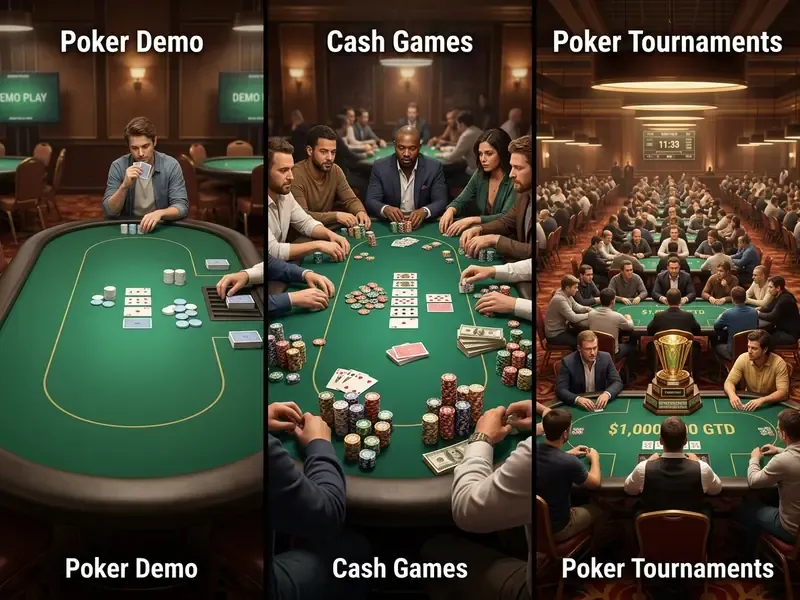
- Formats. Online poker exists in four genuinely different shapes: free poker demo / free poker (virtual chips), cash games (chips equal money), poker tournaments (fixed buy-in, rising blinds) and live dealer poker, where you play against the house with a real dealer on a video stream.
- Legal status. Under the Interactive Gambling Act 2001, offering real money online poker to Australian residents is prohibited, no matter where the operator is registered. Only simulated (free-play) products are legally available.
- Tax. For recreational players, winnings are usually not treated as taxable income (incidental income). Systematic professional play may be treated as a business activity and taxed accordingly.
- Payments. Since June 2024, credit cards and cryptocurrency cannot be used to fund gambling accounts in Australia. The channels that actually work are PayID, bank transfer, debit cards and licensed e-wallets.
- The main rule. Check the licence, the KYC process, withdrawal limits and wagering terms before you deposit. If control slips, use the national self-exclusion register BetStop and the helpline 1800 858 858.

Online poker spans several distinct formats, ranging from risk-free demo practice and multi-table tournaments to live dealer casino tables and cash games. Understanding the specific mechanics, hand rankings, wagering conditions and regulatory frameworks matters before you open an account or put real money at risk.
"A sensible approach to online poker begins with examining the regulatory environment, account terms and structural risks before focusing on promotional claims or potential payouts. Understanding wagering limits, withdrawal rules and responsible play tools keeps entertainment controlled and transparent." Claire Bennett, Senior iGaming Editor (fictional editorial persona)
Poker online: which game formats are available
Online poker splits into two structural categories: peer-to-peer poker games, where players compete against each other in cash games or tournaments, and casino-style table games, where players bet against the house or a live dealer. In Australia, interactive gambling is strictly governed by the Interactive Gambling Act 2001 (IGA), under which providing real money online casino products and unlicensed poker services to residents is prohibited (Australian Communications and Media Authority [ACMA], 2024). So evaluating poker games starts with one question: is this platform a regulated free-to-play demo environment, an offshore casino operator, or a land-based venue?

"Between April and June 2024, 12 breaches were recorded for providing prohibited interactive gambling services, including online poker." ACMA, Action on Interactive Gambling, April to June 2024. https://www.acma.gov.au
The practical takeaway is unglamorous. A polished lobby and fluent English support do not mean an operator may legally serve an Australian resident. Liability under the IGA 2001 sits with the operator, not the player, yet the player carries the real risks: no access to Australian consumer protection mechanisms, no ability to ask ACMA for a refund, the chance of a domain block mid-tournament, and no guarantee that a withdrawal request will be processed at all.
Cash games and poker tournaments
In peer-to-peer online poker, cash games and tournaments represent two fundamentally different structures of betting, time commitment and financial risk. In cash games, table chips directly represent money, blinds stay at fixed levels, and players can join or leave at any time with their remaining stack. Tournaments work differently: players pay a fixed buy-in to receive a non-monetary chip stack, and blinds escalate at set intervals until one player holds every chip.
"More than two thirds of regular online bettors in Australia report some form of gambling harm." Australian Institute of Family Studies, National Gambling Trends Study (2023). https://aifs.gov.au
From an analytical perspective, cash games allow flexible session lengths but expose players to loss chasing through repeated re-buys. Tournaments cap immediate financial exposure at the entry buy-in, while demanding a fixed time commitment as levels progress. Neither structure is safer by default; they simply fail in different ways.
Tournament poker formats differ by prize pool structure and elimination mechanics:
- Freezeout:the classic format. Lose your chips and you are out, with no re-entry or top-up available.
- Progressive Knockout (PKO) / Bounty:every player carries a cash price on their head. Knock out an opponent and part of their bounty lands in your balance straight away, while the rest is added to your own bounty, so your head grows more valuable as the tournament runs.
- Sit & Go (SNG):no scheduled start time. The game begins once every seat is filled, from heads-up (two players) up to large 180-runner fields.
- Guaranteed tournaments (GTD):events with a guaranteed prize pool that is paid regardless of the final number of entrants, with the operator covering any shortfall (overlay).
- Re-entry / rebuy / add-on:formats that allow a second entry or extra chips inside a set window. These are the ones that turn "risk limited to the buy-in" into potentially unlimited spend, so decide your re-entry cap before the first hand.

| Tournament type | Elimination mechanic | Maximum outlay | Who it suits |
|---|---|---|---|
| Freezeout | One elimination ends your run | Exactly the buy-in | Beginners and players on a strict budget |
| PKO / Bounty | Cash reward for every knockout | Buy-in, or more with re-entry | Aggressive players comfortable with confrontation |
| Sit & Go | Starts when the table fills | Buy-in | Players short on time |
| GTD | Freezeout or re-entry | Depends on structure | Players chasing a larger prize |
Poker demo, free poker and playing for real money
Poker demo modes and free poker platforms let users learn game mechanics, hand values and betting sequences with virtual tokens and no real stake. Moving from free poker to poker real money calls for a careful look at personal limits, platform licensing and account verification rules.
Free poker is a genuinely useful place to master Texas Hold'em rules or Omaha dynamics. Research is blunter than most marketing, though: a risk-free environment does not reproduce the psychological pressure or the financial exposure of money poker.
"Participation in simulated gambling is associated with higher levels of monetary gambling harm on the PGSI scale." Simulated Gambling and Trajectories Study, peer-reviewed (2023). https://aifs.gov.au
Under Australian regulation, lawful online access is confined to non-monetary simulated products, while real money online poker sites operating offshore sit outside Australian consumer protection frameworks such as BetStop (Department of Social Services [DSS], 2024).

Purpose: helps the reader compare online poker formats objectively before starting to play. Semantic mark-up: Markdown table with the full text duplicated in the DOM.
| Parameter | Poker demo / free poker | Cash games | Poker tournaments (MTT / SNG) |
|---|---|---|---|
| Main goal | Learning the rules, testing software, entertainment | Accumulating chips in each individual hand | Climbing the prize ladder into the money (ITM) |
| Betting format | Virtual play-money chips | Direct cash equivalent (real money) | Fixed buy-in plus commission (rake) |
| Session length | Entirely up to the player | Flexible: sit down or leave at any time | Fixed: until elimination or victory |
| Financial risk | None, although in-app purchases of virtual chips may exist | High: a full stack can go in a single hand | Capped at the buy-in, provided there are no rebuys or re-entries |
| Availability in Australia | Legal as simulated gambling | Restricted by law (IGA 2001) | Restricted by law (IGA 2001) |
[⚖️ DISCLAIMER] This information is general in nature and does not replace advice from a qualified professional. The availability of online poker formats, real money conditions and applicable age limits are set by the law of each jurisdiction.
Poker rules: how a hand is played and winners are decided
Every poker game rests on standard card rankings, a strict dealing sequence and structured betting rounds that decide who owns the pot. Whether you are playing online poker, a poker demo, or facing a dealer in a live casino, the objective stays the same: build the strongest five-card combination, or push every rival to fold before showdown.
Texas Hold'em rules for beginners
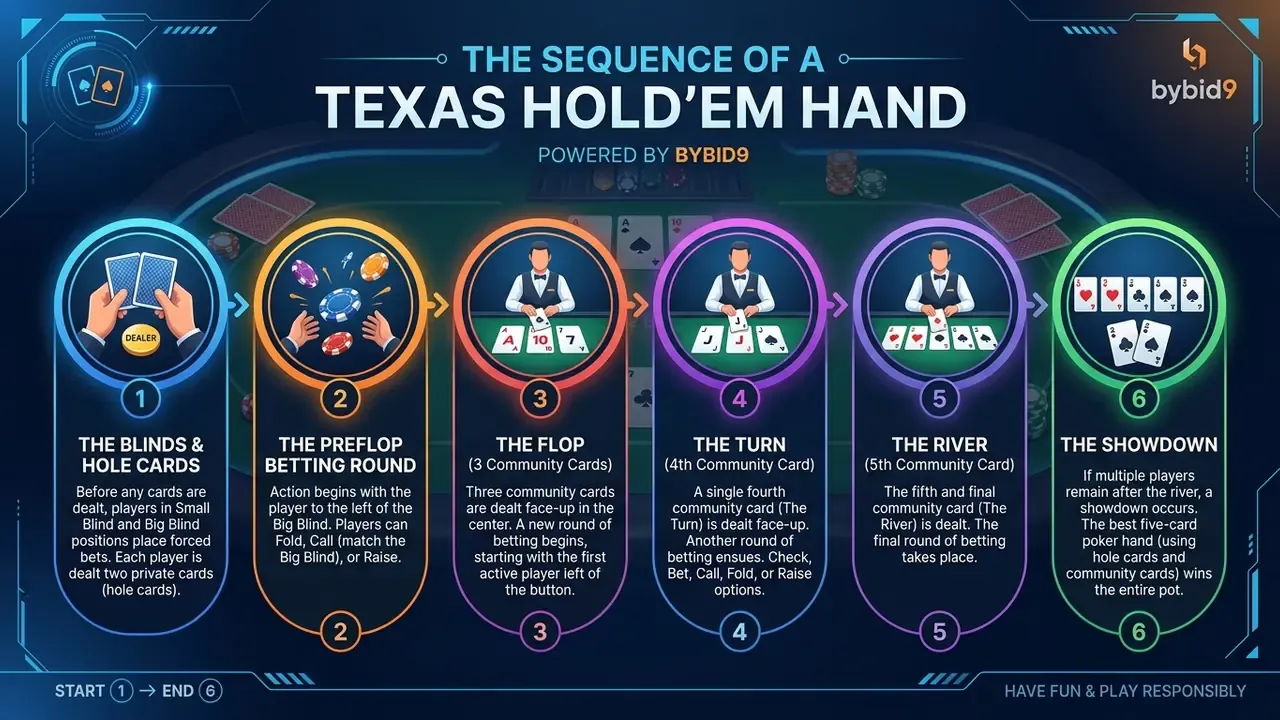
Texas Hold'em is the most widely played poker discipline in the world. Each player receives two private cards (hole cards), followed by five community cards dealt face up across three stages: the flop (three cards), the turn (one card) and the river (one card).
To find the winning hand, players combine their two hole cards with the five community cards and build the highest-ranking five-card holding under the standard hierarchy:
- Royal Flush: A, K, Q, J, 10 of the same suit.
- Straight Flush: five consecutive cards of the same suit.
- Four of a Kind: four cards of equal rank.
- Full House: three of a kind plus a pair.
- Flush: five non-consecutive cards of the same suit.
- Straight: five consecutive cards of mixed suits.
- Three of a Kind: three cards of equal rank.
- Two Pair: two separate pairs.
- One Pair: two cards of equal rank.
- High Card: the highest single card when no combination forms.
Suits never raise the rank of a pair, set, straight or full house. Identical combinations split the pot, and the highest side card (kicker) breaks the tie. Clear technical disclosures about random number generators (RNG), shuffle certification and dealing order noticeably improve user comprehension and cut arguments over hand outcomes. That documentation is normally published by licensed casino platforms in the fairness or game rules section of the site.

Omaha and Omaha Hi-Lo rules for more experienced players
Unlike Texas Hold'em, classic Omaha deals four hole cards to every player. The rule that trips people up: you must use exactly two cards from your hand and exactly three from the board. Four hearts in your hand is not a flush. A three-suited board will not rescue you without two matching cards in hand, which is the classic mistake made by players crossing over from Hold'em.
The betting structure mirrors Hold'em (pre-flop, flop, turn, river), yet the average strength of a winning hand is much higher. A set or two pair loses at showdown far more often than Hold'em players expect.
In Omaha Hi-Lo (split pot, 8-or-better) the pot for each hand is divided in two:

- The Hi half:goes to the strongest conventional combination.
- The Lo half:paid for the best "low" holding, five cards of different ranks, all eight or lower, with the Ace counting as the lowest card. The perfect Lo is A-2-3-4-5, known as the wheel. If nobody makes a qualifying Lo hand, the Hi hand scoops the lot.
- Scoop:a single hand can take both halves, which is why suited A-2-3-4 holdings with an ace are treated as premium.

| Discipline | Hole cards | Combination rule | Pot structure |
|---|---|---|---|
| Texas Hold'em | 2 | Any 5 from 7 | Single winner or split |
| Omaha | 4 | Strictly 2 from hand plus 3 from board | Single winner or split |
| Omaha Hi-Lo | 4 | Strictly 2 from hand plus 3 from board, judged separately for Hi and Lo | Pot divided between Hi and Lo |
Betting order and actions at the poker table
Action at a poker table moves clockwise around the dealer button. Before the cards come out, forced bets known as the small blind and big blind are posted by the two players to the left of the button, which creates a starting pot.
In each betting round, players choose from five actions depending on what has happened before them:
- Check:pass the action along without wagering chips, available only if no bet has been made in the current round.
- Bet:place the first wager of the round.
- Call:match the current highest wager.
- Raise:increase the active wager, forcing later players to call the higher amount or fold.
- Fold:discard your hole cards and give up any claim on the pot.


Purpose: visualise the betting stages and card reveal order for new players. Semantics: numbered text diagram with alt="poker rules".
[STAGE 1: Pre-Flop] --> Each player receives 2 hole cards. Betting round starts with the player left of the big blind.
|
[STAGE 2: The Flop] --> 3 community cards are dealt. Second betting round starts with the first active player left of the button.
|
[STAGE 3: The Turn] --> A 4th community card is dealt. Third betting round.
|
[STAGE 4: The River] --> The 5th community card is dealt. Final betting round.
|
[STAGE 5: Showdown] --> Remaining players reveal their cards. Five-card hands are compared and the winner is decided.
Poker strategy for beginners: the basic approach
A disciplined poker strategy rests on four pillars: starting hand selection, position relative to the dealer button, bankroll management and basic pot odds. It makes sense to work on strategy straight after the rules, well before you register an account or make a first deposit.
Choosing hands and making betting decisions
The most common beginner error is playing too many weak starting hands out of position. Sound pre-flop play rewards fold discipline plus selective aggression with premium holdings.
Starting hands fall into four broad tiers:
- Premium pairs:AA, KK, QQ, JJ. Strong holdings for raising and re-raising pre-flop.
- Big high-card combinations:AK, AQ, AJ, suited or offsuit. Powerful hands that benefit from a favourable flop texture.
- Suited connectors:J-10, 10-9, 9-8 suited. Speculative hands with real potential to make straights or flushes in multi-way pots.
- Marginal or weak hands:unsuited low cards such as 7-2 or 8-3. Fold them and skip the awkward post-flop guesswork.

Why position beats cards, with an example. Position decides how much information you hold before you act. On the button you act last on the flop, turn and river, so you see every opponent's decision before committing chips. From under the gun (UTG) you act first and play the rest of the hand half blind.
A quick illustration. K-J offsuit on the button against one opponent is a standard opening, because you control the pot size and can fold cheaply on a bad board. The same K-J offsuit from an early seat at a nine-handed table is a losing start: seven players sit behind you, any of them can three-bet, and post-flop you must act first every street. That is exactly why published pre-flop charts give narrow ranges from early position and noticeably wider ones from late position.

How strategy differs in cash games and tournament poker
Strategy diverges sharply between cash games and tournaments because of stack depth and blind structure:
- Cash game strategy: built around deep-stack play. By common playing convention, a standard cash-table stack is roughly 100 big blinds or more, which maximises implied odds and lets you focus on the long-run expected value (EV) of each decision without elimination risk.
- Tournament strategy: requires constant adjustment to shrinking stack depth against rising blinds, plus survival pressure and Independent Chip Model (ICM) considerations near pay jumps. Below 15 to 20 big blinds, ranges collapse into push/fold decisions, and on the bubble the value of survival can make folding a technically +EV hand the correct play.

"Loss chasing and rising bet intensity are key behavioural markers of problem gambling in online environments." Online Problem Gambling Behaviour Index (OPGBI), 2023. https://aifs.gov.au
Bankroll management is part of strategy, not an afterthought. For cash games, a conservative benchmark is 30 to 50 buy-ins at your chosen limit; for MTTs, 100 buy-ins or more, since tournament variance is far higher. Dropping down a limit during a downswing is not weakness, it is bankroll protection. Moving up "to win it back faster" is a behavioural risk marker of the exact type described in the research above.
[🚨 E-E-A-T ALERT BOX: RESPONSIBLE PLAY AND FINANCIAL RISK]
WARNING: playing poker for real money carries financial risk. Poker should not be treated as a stable source of income or a way to solve money problems.
Australia operates a national self-exclusion register, BetStop (betstop.gov.au), which blocks access to licensed wagering services. If you or someone close to you is struggling with control over gambling, contact the free Gambling Help Online service on 1800 858 858 or visit gamblinghelponline.org.au.
[⚖️ DISCLAIMER]
This information is general in nature and does not replace advice from a qualified professional. Real money poker carries financial risk, and strategic guidance never guarantees a win.

Who should skip real money play altogether
Some readers genuinely should not move from demo to money poker. Hold off if any of the following applies:
- you are under 18 (or under 21 in certain jurisdictions);
- you plan to play with borrowed funds, a credit line, or money set aside for essential bills;
- you are listed on BetStop, or have previously restricted your own access to gambling;
- you return to the table immediately after a loss to win it back (loss chasing);
- you hide the fact, or the size, of your play from people close to you;
- you play after alcohol or stimulants, or while under heavy emotional stress.
Poker live dealer: how live casino differs from online poker
Poker live dealer games combine a digital betting interface with a real-time video feed of a professional dealer handling physical cards at a physical table. Traditional online poker uses RNG software to deal virtual cards between competing humans. Live casino poker usually sets one player directly against the house, so the outcome depends less on out-playing a rival and more on a paytable with a built-in house edge.
"Between October and December 2023, ACMA blocked 50 sites offering illegal casino services, including poker and live dealer games." ACMA, Action on Interactive Gambling, October to December 2023. https://www.acma.gov.au
Popular live dealer poker games and the technology behind them
Live poker joins a physical dealer to a digital interface. Two pieces of studio infrastructure keep the stream stable and the settlement instant:
- Game Control Unit (GCU): a hardware encoder about the size of a shoebox, fitted under each table. It digitises the video feed in real time and syncs it with the game server. Without it, both player and dealer would face crippling delays.
- Optical Character Recognition (OCR): cameras, in modern studios 4K units with several angles and professional lighting, read the rank and suit of each card dealt, and the system pushes that data straight into the player interface and the hand history.
Live casino platforms run several adapted poker variants built for fast play against the house:

- Live Casino Hold'em:players receive two cards and face the dealer after three community cards appear. The choice is to call and see the remaining cards, or fold the ante. The winner is decided by the standard five-card hierarchy, and ante payouts reach 100:1 in some versions.
- Live Caribbean Stud Poker:a five-card stud variant where you weigh your hand against the dealer's single exposed card before raising or folding. The key rule is dealer qualification: the dealer's hand must contain at least Ace-King, otherwise only the ante is paid. The pay scale runs from even money for a pair up to 100:1 for a royal flush, and the 5+1 Bonus side bet reaches 1000:1 in certain versions.
- Live Texas Hold'em Poker:head-to-head mechanics against the house, often with bonus side bets tied to specific starting hands or premium combinations.
- Live Royal Poker (also known as Russian Poker):an unusual format where, after the initial five cards, you get more than fold or call. You may pay to swap a card or buy a sixth card to improve the hand. A paid "dealer qualification" option is also available when a large payout is at stake.
- Live 3-Card Poker:quick play with three-card hands. The hierarchy shifts here, since a straight outranks a flush, because three consecutive cards are harder to hit. Bets split into Ante, Play and Pair Plus.

| Live discipline | Player cards | Key decision | Distinctive mechanic |
|---|---|---|---|
| Casino Hold'em | 2 plus 5 community | Call or fold after the flop | Classic five-card hierarchy |
| Caribbean Stud | 5 | Raise (2x ante) or fold | Dealer qualifies from Ace-King |
| Royal / Russian Poker | 5, plus 1 optional | Swap, buy, call or fold | Paid hand improvement |
| 3-Card Poker | 3 | Play or fold, plus Pair Plus | Straight beats a flush |
Tables, dealers and the pace of live poker
The operational pace of live dealer poker is set by physical handling, shuffling routines and strict decision timers (shot clocks), usually between 15 and 30 seconds per action. In tournament-style live formats, a 30-second clock with an automatic check or fold on expiry is the most common setting.
Based on industry practice and our own observations, a live table runs much slower than software. Physical dealing, shuffling, chip movement and streaming latency hold the count to roughly 25 to 35 hands per hour, while fast-fold RNG formats can push past 80 hands per hour on a single table. Treat those figures as industry reference points rather than certified statistics: operators do not publish verified hands-per-hour reports, so check the real pace against the hand history in your own account.
One practical conclusion. A slower live pace cuts the number of decisions per hour, yet it does not cut risk. With a high table minimum and a constant house edge, hourly losses can easily exceed those in low-limit RNG poker.
[💬 E-E-A-T BOX: FACT CHECK / VERIFYING LIVE CASINO CONDITIONS]
"Before joining a live dealer game, check the rules of that specific table, the payout tables and the betting limits. Unlike a classic poker room, games against the casino carry a built-in house edge. Confirm that the software provider holds a current licence and that access to the table complies with the law in your jurisdiction."
Editorial and compliance team


How to choose a poker site and assess the value of an offer
Evaluating online poker sites means looking past the headline promotional figure to security measures, software performance, payout terms and regulatory compliance. Under Australian rules, ACMA actively blocks unlicensed offshore casino and poker platforms to shield consumers from unverified operators (ACMA Action on Interactive Gambling, 2024).
"In 2024, 15% of Australian adults experienced or were at risk of gambling harm." Australian Institute of Family Studies, Gambling Participation and Harm Snapshot (2024). https://aifs.gov.au
Games, player traffic and table quality
A functional poker platform needs enough player traffic across stakes and disciplines, Texas Hold'em and Omaha in particular, so that tables actually fill. Assessment covers peak concurrent users, the spread of cash games and tournaments, anti-collusion software standards and support responsiveness.
What to look at when judging traffic and table quality:
- Peak hours. For an Australian player, the overlap between your evening and the network's peak is critical. If most traffic arrives during the European or American night, your table choice at the right limit will be thin.
- Recreational to professional ratio. Tables packed with multi-tabling regulars offer clearly worse conditions for a newcomer.
- Anti-collusion and bot detection. Look for a stated policy against collusion, real-time-assistance software and bots, plus an actual investigation process for suspicious hands.
- Client stability. Frequency of disconnections, availability of all-in protection, and whether the hand history works properly.
[📣 INFORMATION BLOCK]
Reviews of licensed platforms, withdrawal condition tables and plain-English breakdowns of bonus rules sit in the analytical [iGaming](https://bybid9-online.com) section. Informational content only, 18+.

Poker bonuses, rakeback and real money conditions
Poker bonuses, first deposit matches and rakeback rewards exist to encourage activity, but their true value depends entirely on wagering requirements (playthrough conditions) and expiry terms. Rakeback returns a percentage of the administrative fee (rake) the house collects from cash pots or tournament entries. Comparing how operators handle this is easier with reviews of online casinos with transparent bonus terms.
Before accepting any promotion, verify:
- Wagering requirements: how many loyalty points or hands are needed to release bonus funds as withdrawable cash.
- Time restrictions: the calendar window for clearing the bonus, typically 30 to 90 days.
- Withdrawal limits: maximum cashout caps attached to bonus winnings.
- Eligible games: which disciplines count towards the playthrough.

"Deposit frequency and rising play intensity are the strongest predictors of harm risk among online players." Playtech BetBuddy Machine Learning Behavioural Markers Report (2025). https://www.playtech.com
That is exactly why short clearing windows are structurally risky. They push you to deposit more often and play more volume to beat a deadline, rather than because a session made sense.
Payment methods, withdrawal times and KYC
For Australian players, payments are the most common place where money and time disappear. Since June 2024 there is a direct ban on using credit cards and cryptocurrency for gambling-related transactions with operators serving the Australian market. Below is an indicative summary of the channels that remain workable, plus typical processing times.
| Method | Deposit | Typical withdrawal time | Fees | Restrictions and details |
|---|---|---|---|---|
| PayID / Osko | Instant | 0 to 24 hours after approval | Usually none | Personal bank account only, matching the name on the account |
| Bank transfer (EFT) | 1 to 2 business days | 2 to 5 business days | Bank may charge a flat fee | The most reliable channel for larger amounts |
| Debit card (Visa/Mastercard debit) | Instant | 1 to 3 business days | Generally none | Credit cards are prohibited (2024) |
| Licensed e-wallets | Instant | 0 to 48 hours | Wallet fee possible | Wallet ownership must be verified |
| Cryptocurrency | n/a | n/a | n/a | Prohibited for gambling payments in Australia since June 2024 |
| Vouchers / prepaid cards | Instant | Withdrawal not possible | Issuer fee | Deposits only; withdrawals go to a bank account |
Payout rules worth checking before you deposit:
- Source method rule (closed loop). Most operators return funds via the same method used for the deposit, with any balance sent to a bank account.
- KYC before the first withdrawal. The standard pack is photo ID, proof of address (a utility bill or bank statement no older than three months) and proof of ownership of the payment method. A normal review takes anywhere from a few hours to 72 hours.
- Limits. Check the daily, weekly and monthly withdrawal caps, and any separate cap on winnings generated from bonus funds.
- Pending period. The cancellation window on a withdrawal request, usually 12 to 48 hours, is the mechanism that nudges money back into play. Turn off reverse withdrawal if the operator allows it.

Red flags: signs of an unfair poker room
Some signals should stop a registration or a deposit outright:
- KYC verification drags past 72 hours with no clear explanation, or documents are requested again after every withdrawal request.
- No licence details in the footer: no permit number, no legal entity, no regulator; or the licence number cannot be found in the regulator's register.
- Unrealistic bonuses with wagering of 70x or higher, "unlimited" cashback, or promises of guaranteed returns.
- No responsible gambling controls in account settings: no deposit limit, loss limit, time-out or self-exclusion.
- Withdrawal conditions change after registration, or the cashout cap is not stated in the terms and conditions at all.
- Support replies in templates, gives no written ruling on a disputed hand, and offers no downloadable hand history.
- The domain appears on ACMA blocking lists or changes address regularly through mirror sites.
- Reviews mention part payments, where a large win is broken into instalments with no basis in the published terms.

Tax on poker winnings and payment system restrictions
- Recreational status (incidental income):gambling and poker winnings are generally not taxed for most recreational players, because they are treated as the result of a hobby or an incidental windfall and fall outside assessable income.
- Professional status (business activity):where play is systematic, profit-driven, a primary income source and organised in a business-like way, winnings are treated as assessable income and must be declared.
- Illegal activity:income from illegal activity is also taxable in the ATO's view, while related losses and expenses are not deductible.

Important regulatory update (2024): under amendments connected to the Interactive Gambling Act, using credit cards and cryptocurrency to fund accounts with operators serving the Australian market is prohibited. The measure aims to stop players accumulating gambling debt.
[❓ CHECKLIST: Choosing a safe and transparent poker platform] Purpose: help the reader methodically check the key parameters of a site before creating an account. Semantics: interactive structured list of criteria.
- 1. Licence status and jurisdiction: a current permit from a recognised regulator is confirmed, and the site does not appear on ACMA blocking registers.
- 2. Bonus transparency: wagering conditions, minimum rakeback percentage and promo expiry dates have all been read.
- 3. Withdrawal conditions: cashout limits, fees and identity verification (KYC) requirements are clearly stated.
- 4. Software quality and security: SSL encryption, certified RNG and protection against third-party software and bots.
- 5. Customer service: live chat and email available, with realistic response times under 24 hours.
- 6. Payment discipline: deposit and withdrawal methods permitted in your jurisdiction are confirmed, with no hidden fees.
- 7. Responsible gambling tools: deposit and loss limits, time-out and self-exclusion are all available.
[⚖️ E-E-A-T DISCLAIMER / LEGAL NOTICE]
This information is provided for general information only and is not legal, tax or financial advice. The availability of poker casino products, real money rules, age limits (18+ or 21+ depending on the region), payment options and withdrawal conditions are governed by the law of each country. In Australia, the provision of real money online poker is regulated by the Interactive Gambling Act 2001. For questions about tax on winnings, speak to a qualified tax adviser or consult official ATO material.

How to start playing poker: from registration to your first table
Getting started in online poker follows a sequence built to verify identity, set deposit limits and pick sensible stakes. Slower is better here.
How to join a poker table and choose a game
To join a table safely and without fuss, work through these steps:
- Account registration: register with accurate legal details so future KYC identity checks clear without friction.
- Set responsible limits: configure daily or monthly deposit caps in account settings before funding the account.
- Navigate the lobby: filter available games by discipline (Hold'em, Omaha), format (cash, MTT, Sit & Go) and stake level (micro, low, medium).
- Table selection and buy-in: choose stakes appropriate to your total bankroll and buy the required chip stack.
- Check the table settings before you sit: seat count (6-max or full ring), any ante or straddle, all-in protection rules and the action timer.
- Start with the minimum stack, or a demo table, so you can test the interface, dealing speed and hand history before real money is involved.
Worth noting: on some platforms registration only works inside the mobile app rather than the browser, so the exact order of steps depends on how the operator has built things.

When to choose a poker demo instead of money poker
Choosing between a poker demo and real money play comes down to experience and familiarity with the software. Practice modes make sense when you are learning Texas Hold'em rules for the first time, testing a new multi-tabling layout, or trying an unfamiliar format without financial exposure.
Specific scenarios where demo is objectively the better option:
- learning Omaha or Omaha Hi-Lo after Hold'em, since the "two from hand plus three from board" rule needs repetition;
- checking a new layout when you move to four tables or more;
- testing the software on a mobile device, along with your connection quality;
- drilling push/fold decisions on a short stack with no bankroll at risk.
Even so, demo mode is not an automatically safe stepping stone. It does not reproduce the emotional cost of losing, and it can build distorted expectations of what money poker feels like.

"A qualitative study of 89 Australian adolescents aged 12 to 17 found most participants saw simulated gambling as a potential gateway to monetary play." Qualitative Study on Australian Adolescents' Experiences of Simulated Gambling (2023). https://aifs.gov.au
Hence a practical requirement: restrict access to free-play poker on shared home devices where minors are present, and never let "free" be presented as "risk-free".
FAQ about poker online
Editorial note: how this guide is reviewed
This guide is reviewed on a rolling basis, with the last check completed in January 2026. Legal points are matched against current ACMA and Department of Social Services material, tax wording against published ATO guidance, and harm statistics against Australian Institute of Family Studies research. Operator conditions, particularly bonus wagering, withdrawal caps and KYC documents, change without notice, so treat every figure here as a reference point and read the current terms on the site itself before you act. If a term in a poker room's T&Cs contradicts what you read here, the T&Cs win. Play only with money you can afford to lose, set limits early, and use BetStop or 1800 858 858 if play stops feeling like entertainment.